Direct answer: OEM and ODM skincare projects need different levels of buyer input. A clear comparison helps buyers choose between custom formula development, existing formula adjustment, packaging proofing, and launch support.
This buyer guide is written for skincare brand owners, Amazon and TikTok beauty sellers, salon or spa buyers, distributors, and private label teams who need a practical way to speak with a factory before sample or bulk production starts.
Why this matters for a B2B skincare project
GUOCUI BIO TECH is positioned as a skincare OEM/ODM and private label supplier, so the most useful content is not generic beauty copy. A buyer needs to know what information the factory team needs before it can discuss samples, packaging, quotation logic, and production preparation.
The key question behind this topic is OEM ODM skincare manufacturer. The practical angle is buyer decision support: helping the buyer prepare enough detail so the export team, sample team, packaging team, and QC team can work from the same request.
Information buyers should prepare
Product format: serum, cream, cleanser, mask, body care, scalp care, essential oil, or a set.
Formula direction: texture, skin feel, fragrance preference, hero ingredient direction, and claim boundaries.
Packaging direction: bottle, jar, tube, pump, dropper, label, box, carton, and set structure.
Order planning: estimated quantity, target market, sales channel, language needs, and launch timing.
Compliance review: claims, ingredient naming, local label requirements, and buyer-side import documents.
Factory-side review path
Step
What GUOCUI should check
Buyer decision supported
Sample discussion
Texture, scent, skin feel, formula direction, and packaging fit.
Whether the product direction is realistic before bulk work.
Packaging proofing
Capacity, closure, label area, carton layout, and set presentation.
Whether the product can be presented clearly in the buyer’s channel.
Quotation review
Formula, packaging, label work, quantity, timeline, and shipping plan.
Whether MOQ and quotation are ready to confirm.
QC and packing plan
Appearance, filling, sealing, label position, carton marks, and shipment preparation.
Whether the order can move into stable production steps.
FAQ for buyers
Can GUOCUI quote from only a product name? Usually not accurately. Quotation depends on formula, packaging, quantity, label work, and shipping plan.
Can buyers request low MOQ private label directions? Buyers can ask for low MOQ options, but the final MOQ should be confirmed after formula and packaging review.
Can packaging be customized? Packaging can be discussed by bottle, tube, jar, pump, label, box, carton, and set plan. The buyer should provide capacity and channel requirements when possible.
What should be sent before a sample request? Send product format, target market, formula direction, packaging reference, estimated quantity, and expected launch timeline.
Next RFQ action
Before sending an inquiry, prepare one short brief that includes product type, formula direction, packaging idea, quantity range, label language, target market, and sample deadline. This makes the first factory reply more useful and reduces repeated clarification.
Direct answer: a private label facial cleansing bar project should be briefed as a complete product system, not just a bar color and an ingredient name. The useful brief covers the cleansing direction, after-rinse feel, bar dimensions, fragrance choice, packaging structure, label market, sample checks, and the information needed for quotation. Those decisions determine what the factory can sample, what the packaging supplier must prepare, and what the buyer still needs to confirm before production.
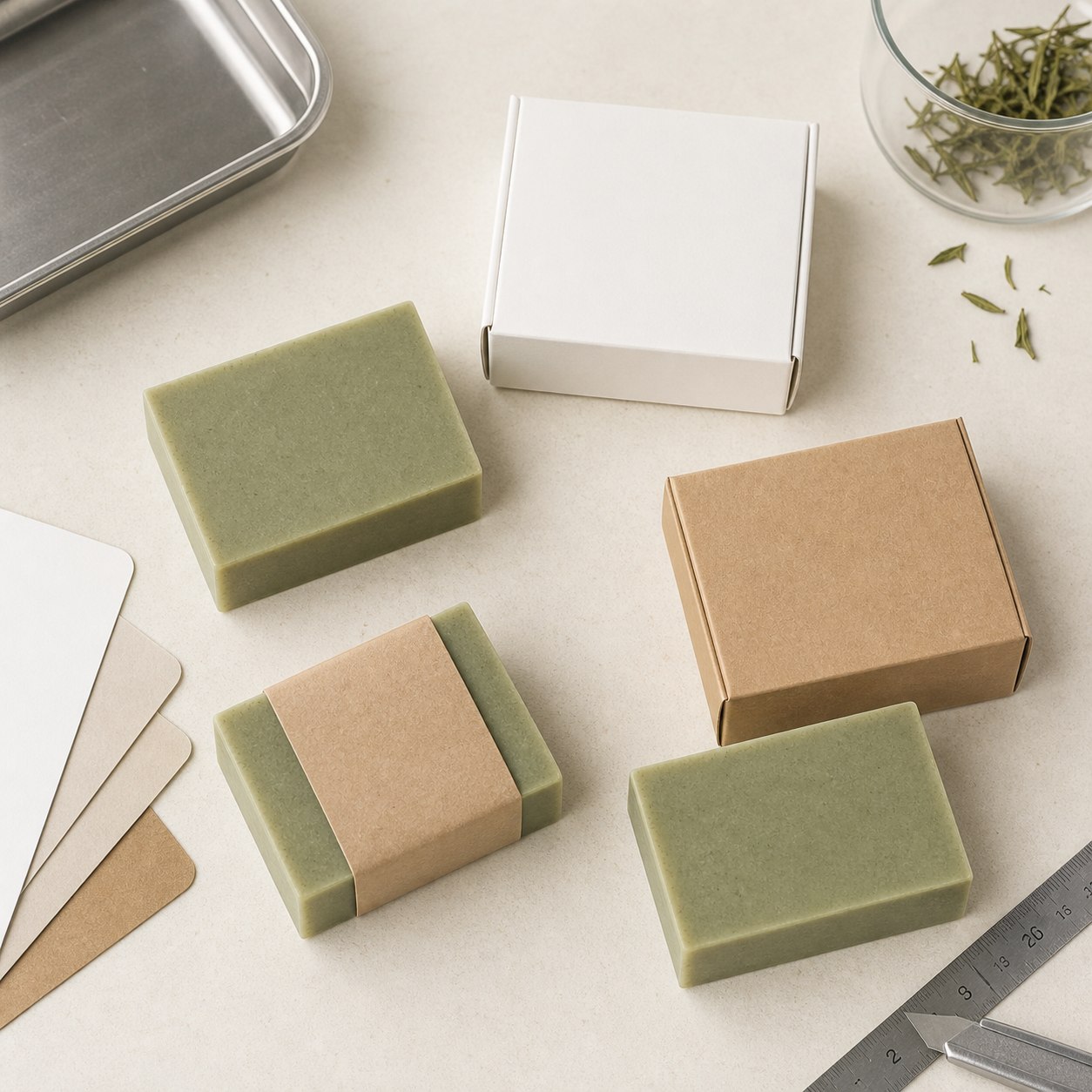
Blank paper bands, cartons and muted-color cleansing bar samples prepared for private label packaging review.
For a brand buyer, distributor, salon group or marketplace seller, the fastest route to a useful quotation is to make the product decisions visible. A short brief lets the formulation, packaging and export teams review the same project instead of solving different versions of it.
What is a private label facial cleansing bar?
A private label facial cleansing bar is a solid facial-cleansing format developed for a buyer’s brand, channel and target market. The factory may work from an available base direction, adjust an existing formula concept, or develop a custom formula after technical review. It should not automatically be described as traditional soap, syndet, pH-balanced or suitable for a particular skin condition unless the actual formula and supporting tests justify that language.
That distinction matters at the first sample meeting. “Green tea bar” is a visual or ingredient direction; it does not define the cleansing system, fragrance, foam, rinse profile, skin feel or permitted claims. The buyer should describe the experience they want and let the technical team confirm which route is feasible.
Decisions to make before the first sample
Buyer decision
Examples to discuss
Why the factory needs it
Target customer and channel
Beauty brand, spa, travel retail, Amazon, TikTok Shop or wholesale
Sets the pack, content and presentation priorities
Cleansing experience
Light or rich foam, quick rinse, low-fragrance or fragrance-free direction
Guides formula and sensory sample work
Appearance
Muted botanical color, plain bar, embossed logo direction or paper band
Affects tooling, artwork and pack-fit review
Pack structure
Bare bar with band, folding carton, inner wrap, travel case or set box
Changes material, size, assembly and quotation inputs
Sales market
Country, language, channel and responsible-party details
Defines the label information that must be reviewed
Brief the formula by experience, not by trend words
A useful formula brief starts with what the buyer wants a user to notice during and after washing. Describe the preferred foam level, slip, rinse speed, fragrance strength, color range and after-rinse feel. If a botanical direction such as green tea, centella or oat is important, identify whether it is part of the ingredient story, the visual concept, or both. The factory can then confirm the available raw-material documentation and the wording that is supportable for the target market.
Avoid asking the supplier to place detox, antibacterial, acne treatment, whitening or guaranteed “natural percentage” statements on the pack without evidence and market review. Cosmetic wording can describe cleansing, a fresh feel, a comfortable after-rinse feel or support for a simple routine when those statements match the formula. Patch-test guidance and directions should also be reviewed for the finished product and destination market.
Choose packaging around handling and channel reality
Solid formats can simplify the visual story, but the packaging still has work to do. A paper band gives buyers a low-component presentation for samples or selected channels. A folding carton gives more room for ingredient, warning, responsible-party and multilingual information. An inner wrap or other moisture-management layer may be considered after compatibility, storage and transport review. A travel case or set box changes the buyer decision again because fit, drainage, insert material and assembly must be checked.
Recent beauty and personal-care packaging programs have kept refill, material reduction and usability in the same conversation. That does not mean every cleansing bar should make a sustainability claim. It means buyers should ask for the material specification, pack weight, recyclability basis, print finish and market-specific claim review before putting an environmental message on the carton. A simple uncoated kraft look is a design choice; it is not proof of a lower-impact pack by itself.
What to inspect at the sample and QC table
The sample review should begin with the real bar and the real pack components. Check the bar dimensions, weight target, edge condition, surface uniformity, color consistency and fragrance against the approved reference. During use testing, note foam, handling, rinse and after-feel instead of relying only on a marketing description.
Next, place the sample into the intended paper band, inner wrap, carton or tray. Confirm fit without crushing, excess movement or difficult removal. Review label placement, barcode quiet space if applicable, artwork margins, readable type size and the order of multilingual information. A final production specification should define what the approved sample looks like and which checks will be repeated before packing.
For export preparation, the buyer and supplier should also confirm the destination market, product identity, nominal content, ingredient list format, warnings, batch or traceability information, responsible-party details and any channel-required fields. Requirements differ by market, so the final label should be reviewed against the applicable rules rather than copied from a competitor package.
How MOQ, quotation and timing are confirmed
There is no responsible single MOQ or price for every facial cleansing bar project. Quotation depends on the formula route, bar size, tooling or embossing, packaging components, print method, quantity, label languages, testing needs and shipping plan. A stock carton with a label may have a different commercial structure from a custom-size printed carton or a multi-piece set.
Sample and production timing can be confirmed after formula and packaging review. A buyer can shorten the first round by supplying the sales market, target quantity range, desired bar weight, pack reference, artwork status, fragrance direction and required launch date in one RFQ.
RFQ checklist for a facial cleansing bar
Target country, sales channel and buyer type.
Desired cleansing and after-rinse experience.
Ingredient or botanical directions that need technical review.
Bar weight, dimensions, color and logo or embossing preference.
Paper band, carton, inner wrap, travel case or set-box direction.
Target quantity range and whether a lower-MOQ packaging route is needed.
Label language, artwork status and responsible-party information.
Sample deadline, launch window and shipping destination.
Yes. A generic LOGO or blank carton can be used as a private label sample placeholder. Final public artwork still needs the buyer’s brand files, required label information and market review.
Can the bar use a botanical color without a strong claim?
Yes. Color, fragrance and ingredient-story directions can be discussed separately from efficacy claims. The finished formula, stability, compatibility and permitted wording still need review.
Is a paper band enough for every market?
No. The correct structure depends on handling, moisture exposure, transport, label space, retail protection and local requirements. A carton or inner layer may be needed after package-fit review.
What should the buyer approve before mass production?
The buyer should approve the formula sample, sensory reference, bar dimensions, pack components, artwork proof, label text and the agreed production specification.
How is the final MOQ confirmed?
MOQ and quotation can be confirmed after formula, packaging, quantity, artwork and order-plan review. Custom cartons, tooling and multi-piece sets may have different minimums from simpler stock-pack routes.
Source context
U.S. FDA Cosmetics Labeling Guide — background for label-information review; destination-market requirements still need project-specific confirmation.
Direct answer: OEM and ODM skincare projects need different levels of buyer input. A clear comparison helps buyers choose between custom formula development, existing formula adjustment, packaging proofing, and launch support.
This buyer guide is written for skincare brand owners, Amazon and TikTok beauty sellers, salon or spa buyers, distributors, and private label teams who need a practical way to speak with a factory before sample or bulk production starts.
Why this matters for a B2B skincare project
GUOCUI BIO TECH is positioned as a skincare OEM/ODM and private label supplier, so the most useful content is not generic beauty copy. A buyer needs to know what information the factory team needs before it can discuss samples, packaging, quotation logic, and production preparation.
The key question behind this topic is OEM ODM skincare manufacturer. The practical angle is buyer decision support: helping the buyer prepare enough detail so the export team, sample team, packaging team, and QC team can work from the same request.
Information buyers should prepare
Product format: serum, cream, cleanser, mask, body care, scalp care, essential oil, or a set.
Formula direction: texture, skin feel, fragrance preference, hero ingredient direction, and claim boundaries.
Packaging direction: bottle, jar, tube, pump, dropper, label, box, carton, and set structure.
Order planning: estimated quantity, target market, sales channel, language needs, and launch timing.
Compliance review: claims, ingredient naming, local label requirements, and buyer-side import documents.
Factory-side review path
Step
What GUOCUI should check
Buyer decision supported
Sample discussion
Texture, scent, skin feel, formula direction, and packaging fit.
Whether the product direction is realistic before bulk work.
Packaging proofing
Capacity, closure, label area, carton layout, and set presentation.
Whether the product can be presented clearly in the buyer’s channel.
Quotation review
Formula, packaging, label work, quantity, timeline, and shipping plan.
Whether MOQ and quotation are ready to confirm.
QC and packing plan
Appearance, filling, sealing, label position, carton marks, and shipment preparation.
Whether the order can move into stable production steps.
FAQ for buyers
Can GUOCUI quote from only a product name? Usually not accurately. Quotation depends on formula, packaging, quantity, label work, and shipping plan.
Can buyers request low MOQ private label directions? Buyers can ask for low MOQ options, but the final MOQ should be confirmed after formula and packaging review.
Can packaging be customized? Packaging can be discussed by bottle, tube, jar, pump, label, box, carton, and set plan. The buyer should provide capacity and channel requirements when possible.
What should be sent before a sample request? Send product format, target market, formula direction, packaging reference, estimated quantity, and expected launch timeline.
Next RFQ action
Before sending an inquiry, prepare one short brief that includes product type, formula direction, packaging idea, quantity range, label language, target market, and sample deadline. This makes the first factory reply more useful and reduces repeated clarification.
Direct answer: MOQ and quotation should not be guessed from a product title alone. They depend on formula, packaging, label work, order quantity, testing needs, shipping plan, and buyer market requirements.
This buyer guide is written for skincare brand owners, Amazon and TikTok beauty sellers, salon or spa buyers, distributors, and private label teams who need a practical way to speak with a factory before sample or bulk production starts.
Why this matters for a B2B skincare project
GUOCUI BIO TECH is positioned as a skincare OEM/ODM and private label supplier, so the most useful content is not generic beauty copy. A buyer needs to know what information the factory team needs before it can discuss samples, packaging, quotation logic, and production preparation.
The key question behind this topic is skincare MOQ quotation. The practical angle is quotation variables: helping the buyer prepare enough detail so the export team, sample team, packaging team, and QC team can work from the same request.
Information buyers should prepare
Product format: serum, cream, cleanser, mask, body care, scalp care, essential oil, or a set.
Formula direction: texture, skin feel, fragrance preference, hero ingredient direction, and claim boundaries.
Packaging direction: bottle, jar, tube, pump, dropper, label, box, carton, and set structure.
Order planning: estimated quantity, target market, sales channel, language needs, and launch timing.
Compliance review: claims, ingredient naming, local label requirements, and buyer-side import documents.
Factory-side review path
Step
What GUOCUI should check
Buyer decision supported
Sample discussion
Texture, scent, skin feel, formula direction, and packaging fit.
Whether the product direction is realistic before bulk work.
Packaging proofing
Capacity, closure, label area, carton layout, and set presentation.
Whether the product can be presented clearly in the buyer’s channel.
Quotation review
Formula, packaging, label work, quantity, timeline, and shipping plan.
Whether MOQ and quotation are ready to confirm.
QC and packing plan
Appearance, filling, sealing, label position, carton marks, and shipment preparation.
Whether the order can move into stable production steps.
FAQ for buyers
Can GUOCUI quote from only a product name? Usually not accurately. Quotation depends on formula, packaging, quantity, label work, and shipping plan.
Can buyers request low MOQ private label directions? Buyers can ask for low MOQ options, but the final MOQ should be confirmed after formula and packaging review.
Can packaging be customized? Packaging can be discussed by bottle, tube, jar, pump, label, box, carton, and set plan. The buyer should provide capacity and channel requirements when possible.
What should be sent before a sample request? Send product format, target market, formula direction, packaging reference, estimated quantity, and expected launch timeline.
Next RFQ action
Before sending an inquiry, prepare one short brief that includes product type, formula direction, packaging idea, quantity range, label language, target market, and sample deadline. This makes the first factory reply more useful and reduces repeated clarification.
Private label eye patch packaging is the combined review of the sachet, artwork, cosmetic claims, patch count, seal area, label language and sample condition before an OEM/ODM order moves into production. A polished front panel is not enough. The buyer and factory need to confirm that the wording can be supported, the pack matches the actual product, the artwork leaves room for reliable sealing, and the final sample still looks right after filling and handling.
For GUOCUI BIO TECH, this is a practical pre-production gate. Guangzhou Guocui Biological Technology Co., Ltd. can discuss hydrogel eye patch format, custom formula direction, patch color, sachet style, LOGO placement, carton or set structure and export-facing label needs. MOQ, quotation, sample timing and production timing are confirmed only after formula, packaging, quantity, artwork and shipping-plan review.
Neutral hydrogel eye patch sachet samples arranged for artwork and packaging review at a GUOCUI QC table.
Direct answer: what should be approved before production?
Approve the product format, patch count per sachet, formula direction, patch shape and color, sachet material, front and back artwork, ingredient list source, directions, warnings, responsible-party details, batch or date marking plan, barcode, carton plan and target-market language. Then review a physical or production-representative sample for seal quality, leakage, artwork position, text legibility and product appearance.
Why an eye patch sachet needs a separate review gate
Eye patches combine a moist cosmetic format with a small flexible package. That creates decisions that are easy to miss in a standard skincare brief. The front panel has limited space. The back panel may need directions, warnings and multilingual information. A design that looks spacious on a screen can become crowded after the seal margin, tear notch, barcode and required copy are placed.
Claims also need disciplined handling. A buyer may bring a mood board containing percentages, test-result language, origin claims, treatment-style promises or a competitor package. Those references can explain a market direction, but they should not be copied into public artwork without evidence and a target-market review. GUOCUI uses the reference to clarify the desired product and channel, then develops a separate custom-label route.
Artwork and claim review table
Review item
Buyer should provide
Factory-side check
Release condition
Product identity
Hydrogel eye patch name, patch count and intended cosmetic use.
Name matches the filled format and does not imply an unverified treatment.
Front, back, carton and specification use one consistent identity.
Claims
Proposed cosmetic wording and evidence available to the buyer.
Remove unsupported numbers, medical language and borrowed competitor phrases.
Wording is supportable, market-appropriate and consistent with the formula brief.
Artwork
Editable logo, color references, barcode and language files.
Check trim, seal margin, tear notch, contrast, small text and version control.
Approved proof identifies the correct size, material and revision.
Formula and patch
Ingredient direction, exclusions, patch color, scent preference and skin-feel target.
Confirm feasibility, sample route and compatibility with the chosen pack.
Approved sample or signed specification records the final direction.
Pack-out
Single sachet, carton quantity, set configuration and shipping destination.
Review carton, label, outer-case marking and handling needs.
Quotation and packing plan reflect the same approved components.
Build the claim hierarchy from the evidence backward
Start with what the product is, how it is used and what the buyer can substantiate. A safe hierarchy normally begins with a descriptive product identity, followed by texture, format, cosmetic positioning and use instructions. Quantified performance, clinical-sounding language, medical outcomes and certification-style badges require a separate evidence and regulatory review. They should not be added only because they appeared on a supplier image or a marketplace listing.
The same principle applies to ingredient storytelling. Cucumber, caffeine, peptides, fermented ingredients or other cosmetic directions can be discussed during custom-formula development, but the final ingredient list and public wording must follow the formula that will actually be supplied. A concept title is not a substitute for the approved formula record.
Sachet artwork details buyers often overlook
Seal margin: keep important text and visual elements away from the sealing area and tear notch.
Patch count: specify whether the sachet contains one pair, multiple pairs or another format.
Front-to-back consistency: product name, color direction, quantity and formula version should agree.
Language ownership: identify who supplies and approves translations for the destination market.
Barcode and batch information: reserve usable space before visual design is considered final.
Finish and contrast: metallic or reflective areas can reduce legibility even when the screen proof looks clear.
Carton relationship: the outer box, sachet and product specification should use the same version.
What a production-representative sample should check
Sample review is not only a formula evaluation. The buyer should inspect patch shape, color consistency, serum level, handling, sachet condition, opening experience and whether the printed pack matches the agreed concept. The factory team can also check fill, seal, label or print position, carton fit and packing preparation. Any change after approval should be recorded as a new revision rather than handled through an informal message alone.
For channel planning, an Amazon or TikTok beauty seller may prioritize a clear front panel and image-friendly color system. A salon or spa buyer may need professional pack-out and easy stock handling. A distributor may need multilingual copy and a carton structure that supports several markets. These are packaging and communication decisions, not proof of product performance.
MOQ, quotation and timing logic
There is no responsible universal MOQ or fixed quotation for every private label eye patch project. Cost and minimums depend on formula, hydrogel format, sachet material and size, print method, carton or set configuration, number of artwork versions, quantity, label requirements and shipping plan. Sample and production timing can be confirmed after the formula and packaging route is reviewed. Buyers receive a more useful answer when they send those variables with the first inquiry.
Buyer brief to send GUOCUI
Target market and sales channel.
Hydrogel eye patch positioning and preferred patch count.
Formula direction, ingredient exclusions, texture and patch color.
Sachet size, finish, LOGO file, carton or set requirement.
Proposed claims and the evidence available for them.
Label languages, barcode ownership and required market information.
Estimated order quantity, launch window and shipping destination.
Factory-side release sequence
Brief review: the buyer provides channel, market, formula, packaging, artwork and order-plan information.
Risk removal: unsupported claims, copied marks, proprietary phrases and confusing visual references are removed from the public concept.
Sample route: formula direction, patch format, color, sachet and available packaging route are agreed.
Artwork proof: the buyer checks the exact file revision, languages, count, barcode, LOGO and carton relationship.
QC and packing check: fill, seal, print position, appearance, carton fit and shipment preparation are reviewed against the approved specification.
Can GUOCUI develop a custom formula hydrogel eye patch?
GUOCUI can review custom formula, patch color, sachet, LOGO, label, carton and set directions. Final feasibility, MOQ, quotation and timing depend on the approved formula, components, quantity and market requirements.
Can a competitor sachet be used as the production artwork?
No. It may be used internally to explain a format or channel, but the public product should have separately developed naming, wording, color system, layout and artwork. Competitor trademarks, proprietary copy, images and distinctive trade dress should be removed.
When should claims be approved?
Claims should be reviewed before artwork release and checked again against the final formula and destination-market requirements. Unsupported numbers, treatment promises and evidence-style badges should not be carried forward from a reference image.
What happens if final artwork is not ready?
A neutral sample or generic LOGO placeholder may support early packaging discussion. Mass-production artwork still needs a controlled proof and buyer approval before release.
Short conclusion: approve evidence, artwork and the physical pack as one controlled eye patch specification. This reduces avoidable revisions and gives the factory a clearer basis for sampling, quotation, QC and packing.
Direct answer: MOQ and quotation should not be guessed from a product title alone. They depend on formula, packaging, label work, order quantity, testing needs, shipping plan, and buyer market requirements.
This buyer guide is written for skincare brand owners, Amazon and TikTok beauty sellers, salon or spa buyers, distributors, and private label teams who need a practical way to speak with a factory before sample or bulk production starts.
Why this matters for a B2B skincare project
GUOCUI BIO TECH is positioned as a skincare OEM/ODM and private label supplier, so the most useful content is not generic beauty copy. A buyer needs to know what information the factory team needs before it can discuss samples, packaging, quotation logic, and production preparation.
The key question behind this topic is skincare MOQ quotation. The practical angle is quotation variables: helping the buyer prepare enough detail so the export team, sample team, packaging team, and QC team can work from the same request.
Information buyers should prepare
Product format: serum, cream, cleanser, mask, body care, scalp care, essential oil, or a set.
Formula direction: texture, skin feel, fragrance preference, hero ingredient direction, and claim boundaries.
Packaging direction: bottle, jar, tube, pump, dropper, label, box, carton, and set structure.
Order planning: estimated quantity, target market, sales channel, language needs, and launch timing.
Compliance review: claims, ingredient naming, local label requirements, and buyer-side import documents.
Factory-side review path
Step
What GUOCUI should check
Buyer decision supported
Sample discussion
Texture, scent, skin feel, formula direction, and packaging fit.
Whether the product direction is realistic before bulk work.
Packaging proofing
Capacity, closure, label area, carton layout, and set presentation.
Whether the product can be presented clearly in the buyer’s channel.
Quotation review
Formula, packaging, label work, quantity, timeline, and shipping plan.
Whether MOQ and quotation are ready to confirm.
QC and packing plan
Appearance, filling, sealing, label position, carton marks, and shipment preparation.
Whether the order can move into stable production steps.
FAQ for buyers
Can GUOCUI quote from only a product name? Usually not accurately. Quotation depends on formula, packaging, quantity, label work, and shipping plan.
Can buyers request low MOQ private label directions? Buyers can ask for low MOQ options, but the final MOQ should be confirmed after formula and packaging review.
Can packaging be customized? Packaging can be discussed by bottle, tube, jar, pump, label, box, carton, and set plan. The buyer should provide capacity and channel requirements when possible.
What should be sent before a sample request? Send product format, target market, formula direction, packaging reference, estimated quantity, and expected launch timeline.
Next RFQ action
Before sending an inquiry, prepare one short brief that includes product type, formula direction, packaging idea, quantity range, label language, target market, and sample deadline. This makes the first factory reply more useful and reduces repeated clarification.
Direct answer: A sample review should check texture, scent, skin feel, packaging fit, label direction, buyer feedback, and production feasibility before moving into bulk private label skincare planning.
This buyer guide is written for skincare brand owners, Amazon and TikTok beauty sellers, salon or spa buyers, distributors, and private label teams who need a practical way to speak with a factory before sample or bulk production starts.
Why this matters for a B2B skincare project
A sample approved for texture can still need packaging and label work. GUOCUI BIO TECH / Guangzhou Guocui Biological Technology Co., Ltd. uses the buyer brief to discuss these separate decisions before quotation and production planning.
A useful private label skincare sample review gives the export, sample, packaging and QC teams a common record of the requested product and the decisions still open.
Information buyers should prepare
Product format: serum, cream, cleanser, mask, body care, scalp care, essential oil, or a set.
Formula direction: texture, skin feel, fragrance preference, hero ingredient direction, and claim boundaries.
Packaging direction: bottle, jar, tube, pump, dropper, label, box, carton, and set structure.
Order planning: estimated quantity, target market, sales channel, language needs, and launch timing.
Compliance review: claims, ingredient naming, local label requirements, and buyer-side import documents.
Factory-side review path
Step
What GUOCUI should check
Buyer decision supported
Sample discussion
Texture, scent, skin feel, formula direction, and packaging fit.
Whether the product direction is realistic before bulk work.
Packaging proofing
Capacity, closure, label area, carton layout, and set presentation.
Whether the product can be presented clearly in the buyer’s channel.
Quotation review
Formula, packaging, label work, quantity, timeline, and shipping plan.
Whether MOQ and quotation are ready to confirm.
QC and packing plan
Appearance, filling, sealing, label position, carton marks, and shipment preparation.
Whether the order can move into stable production steps.
FAQ for buyers
Can GUOCUI quote from only a product name? Usually not accurately. Quotation depends on formula, packaging, quantity, label work, and shipping plan.
Can buyers request low MOQ private label directions? Buyers can ask for low MOQ options, but the final MOQ should be confirmed after formula and packaging review.
Can packaging be customized? Packaging can be discussed by bottle, tube, jar, pump, label, box, carton, and set plan. The buyer should provide capacity and channel requirements when possible.
What should be sent before a sample request? Send product format, target market, formula direction, packaging reference, estimated quantity, and expected launch timeline.
Next RFQ action
Before sending an inquiry, prepare one short brief that includes product type, formula direction, packaging idea, quantity range, label language, target market, and sample deadline. This makes the first factory reply more useful and reduces repeated clarification.
Worked example: keep a salt scrub sample and its label on the same revision
For a single-jar salt scrub, start the discussion with the intended body-use instructions, a rinse preference and a package route. Keep a reference photograph in a separate research folder. It can communicate a broad texture or format question, but it cannot confirm the raw materials, salt origin, net contents, approved label or suitability for another application area. The purpose of the first sample is to resolve those questions, not to recreate the photograph.
In this example, citrus describes a scent preference. It does not establish that orange oil is present. Ask for the actual proposed ingredient information and fragrance documentation before drafting the ingredient panel. Likewise, an off-white sample and a yellow sample should be compared under agreed conditions; their appearance does not establish their composition or performance. GUOCUI can discuss a different visual identity once the buyer has selected a workable sample route.
AI-generated development illustration; not a photograph of GUOCUI facilities, staff, an approved formula or a completed inspection.
Use a short approval record instead of a string of sample photos
Give each proposed formula a sample code and revision. Record the package component beside it, even if the first sample arrives in a temporary cup. When the buyer requests a softer particle feel, a different scent or another liner, show what changed and what stayed the same. Do not transfer an approval from the previous sample to the new version without checking the affected points.
Review item
Record to keep
Question before approval
Particle and base
Sample code, particle grade and base revision
Are spread, cushion, rinse and residue acceptable for the intended body-use brief?
Package contact
Jar material, opening, liner and closure reference
Which compatibility and closure checks remain open for this component combination?
Fragrance and label
Fragrance reference, proposed ingredients and artwork revision
Does the wording describe the actual proposal rather than the reference image?
Order plan
Quantity per formula, decoration, carton and destination
Is the quotation based on the same approved configuration?
Separate sensory feedback from evidence of safety or performance
A buyer’s comment that a sample feels smoother is useful sensory feedback. It is not a test result for every skin type, an approval for facial use or proof of a treatment effect. Keep those decisions separate. If the sales plan changes from an adult body product to a face, foot or children’s product, reopen the intended-use, formula and safety review before carrying over the original label. Any proposed performance wording needs evidence appropriate to the finished product and destination market.
Agree what is still open before discussing production dates
At the end of the review, mark each item approved, awaiting a revised sample or requiring further evidence. A visually acceptable jar can still have unresolved liner, closure, artwork or formula-contact questions. Sample and production timing should therefore be confirmed against the remaining work, component availability and the buyer’s approval schedule. A requested launch date is a planning input, not a confirmed production commitment.
For this route, start with the single-jar sea salt body scrub direction. A project with several formulas or scents can instead review the coordinated salt scrub collection. Both routes need clear quantity and artwork decisions; a collection adds variant control rather than proving that each jar needs a separate formula.
Reference boundaries
The FDA Cosmetics Labeling Guide and IFRA Standards library are reference starting points for the responsible reviewers. They do not approve this proposed product. This worked example is GUOCUI factory-side planning guidance reviewed on 29 August 2026, not a new regulation, a production case study or a claim that a particular sample has passed testing.
Practical conclusion: Keep the sample code, package reference, ingredient proposal, label revision and quantity plan together. Then send the GUOCUI team the unresolved questions. Review customization options and body scrub directions before choosing the next sample.
Direct answer: A sample review should check texture, scent, skin feel, packaging fit, label direction, buyer feedback, and production feasibility before moving into bulk private label skincare planning.
This buyer guide is written for skincare brand owners, Amazon and TikTok beauty sellers, salon or spa buyers, distributors, and private label teams who need a practical way to speak with a factory before sample or bulk production starts.
Why this matters for a B2B skincare project
GUOCUI BIO TECH is positioned as a skincare OEM/ODM and private label supplier, so the most useful content is not generic beauty copy. A buyer needs to know what information the factory team needs before it can discuss samples, packaging, quotation logic, and production preparation.
The key question behind this topic is private label skincare samples. The practical angle is sample review: helping the buyer prepare enough detail so the export team, sample team, packaging team, and QC team can work from the same request.
Information buyers should prepare
Product format: serum, cream, cleanser, mask, body care, scalp care, essential oil, or a set.
Formula direction: texture, skin feel, fragrance preference, hero ingredient direction, and claim boundaries.
Packaging direction: bottle, jar, tube, pump, dropper, label, box, carton, and set structure.
Order planning: estimated quantity, target market, sales channel, language needs, and launch timing.
Compliance review: claims, ingredient naming, local label requirements, and buyer-side import documents.
Factory-side review path
Step
What GUOCUI should check
Buyer decision supported
Sample discussion
Texture, scent, skin feel, formula direction, and packaging fit.
Whether the product direction is realistic before bulk work.
Packaging proofing
Capacity, closure, label area, carton layout, and set presentation.
Whether the product can be presented clearly in the buyer’s channel.
Quotation review
Formula, packaging, label work, quantity, timeline, and shipping plan.
Whether MOQ and quotation are ready to confirm.
QC and packing plan
Appearance, filling, sealing, label position, carton marks, and shipment preparation.
Whether the order can move into stable production steps.
FAQ for buyers
Can GUOCUI quote from only a product name? Usually not accurately. Quotation depends on formula, packaging, quantity, label work, and shipping plan.
Can buyers request low MOQ private label directions? Buyers can ask for low MOQ options, but the final MOQ should be confirmed after formula and packaging review.
Can packaging be customized? Packaging can be discussed by bottle, tube, jar, pump, label, box, carton, and set plan. The buyer should provide capacity and channel requirements when possible.
What should be sent before a sample request? Send product format, target market, formula direction, packaging reference, estimated quantity, and expected launch timeline.
Next RFQ action
Before sending an inquiry, prepare one short brief that includes product type, formula direction, packaging idea, quantity range, label language, target market, and sample deadline. This makes the first factory reply more useful and reduces repeated clarification.
Direct answer: Packaging decisions affect sample cost, label proofing, carton planning, filling compatibility, and final quotation, so buyers should confirm bottle, cap, pump, label, box, and carton needs early.
This buyer guide is written for skincare brand owners, Amazon and TikTok beauty sellers, salon or spa buyers, distributors, and private label teams who need a practical way to speak with a factory before sample or bulk production starts.
Why this matters for a B2B skincare project
GUOCUI BIO TECH is positioned as a skincare OEM/ODM and private label supplier, so the most useful content is not generic beauty copy. A buyer needs to know what information the factory team needs before it can discuss samples, packaging, quotation logic, and production preparation.
The key question behind this topic is custom skincare packaging. The practical angle is packaging proofing: helping the buyer prepare enough detail so the export team, sample team, packaging team, and QC team can work from the same request.
Information buyers should prepare
Product format: serum, cream, cleanser, mask, body care, scalp care, essential oil, or a set.
Formula direction: texture, skin feel, fragrance preference, hero ingredient direction, and claim boundaries.
Packaging direction: bottle, jar, tube, pump, dropper, label, box, carton, and set structure.
Order planning: estimated quantity, target market, sales channel, language needs, and launch timing.
Compliance review: claims, ingredient naming, local label requirements, and buyer-side import documents.
Factory-side review path
Step
What GUOCUI should check
Buyer decision supported
Sample discussion
Texture, scent, skin feel, formula direction, and packaging fit.
Whether the product direction is realistic before bulk work.
Packaging proofing
Capacity, closure, label area, carton layout, and set presentation.
Whether the product can be presented clearly in the buyer’s channel.
Quotation review
Formula, packaging, label work, quantity, timeline, and shipping plan.
Whether MOQ and quotation are ready to confirm.
QC and packing plan
Appearance, filling, sealing, label position, carton marks, and shipment preparation.
Whether the order can move into stable production steps.
FAQ for buyers
Can GUOCUI quote from only a product name? Usually not accurately. Quotation depends on formula, packaging, quantity, label work, and shipping plan.
Can buyers request low MOQ private label directions? Buyers can ask for low MOQ options, but the final MOQ should be confirmed after formula and packaging review.
Can packaging be customized? Packaging can be discussed by bottle, tube, jar, pump, label, box, carton, and set plan. The buyer should provide capacity and channel requirements when possible.
What should be sent before a sample request? Send product format, target market, formula direction, packaging reference, estimated quantity, and expected launch timeline.
Next RFQ action
Before sending an inquiry, prepare one short brief that includes product type, formula direction, packaging idea, quantity range, label language, target market, and sample deadline. This makes the first factory reply more useful and reduces repeated clarification.