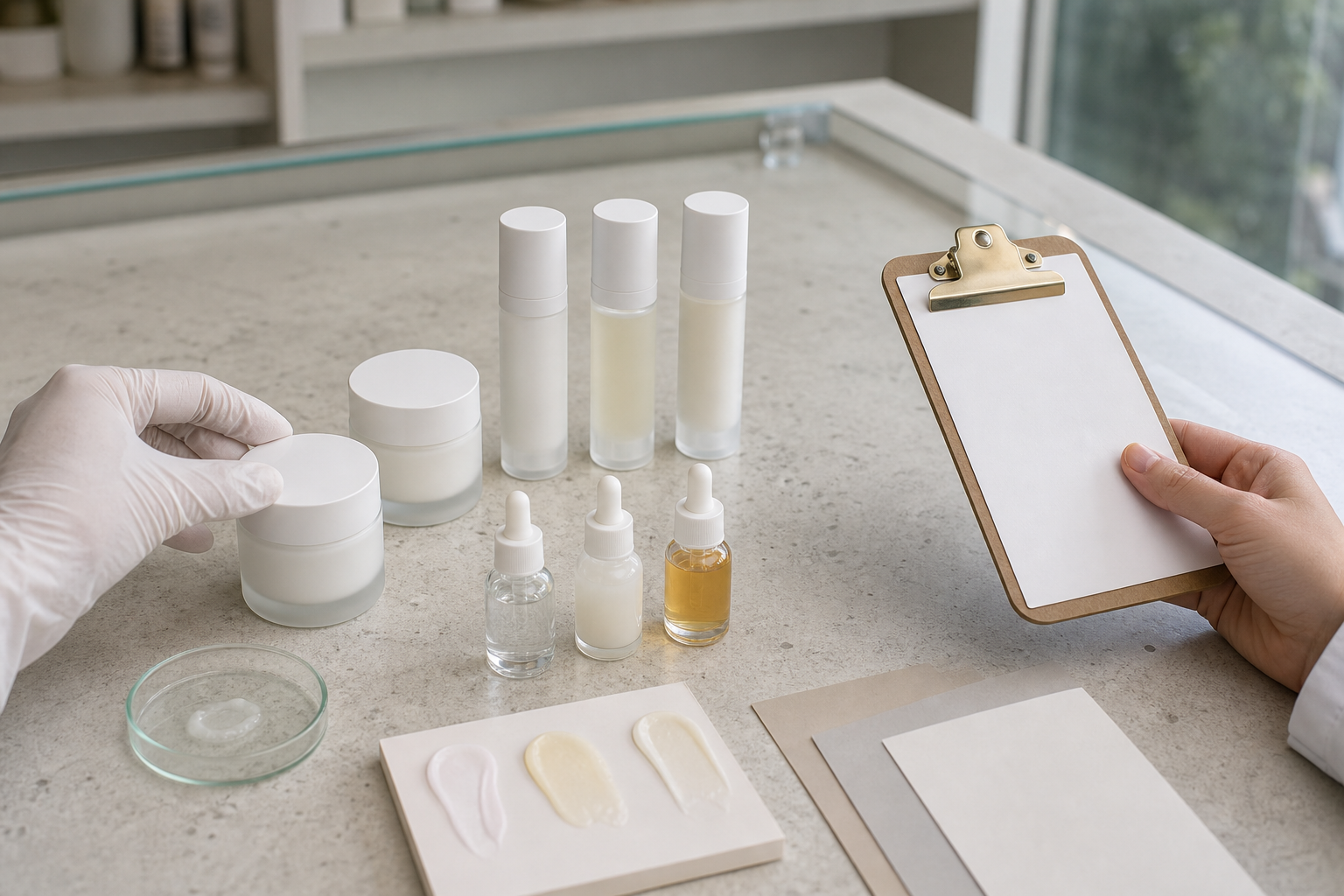
Direct answer: a brand can build modular personalized skincare without collecting genetic data by defining a small set of validated base formulas, a controlled menu of formula variants, and a questionnaire that routes shoppers to an approved SKU. Personalization happens through product architecture and buyer choices, not through medical diagnosis or untested mixing.
A July 2026 consumer launch brought DNA-guided skincare back into the industry conversation. That is a useful signal, but it does not mean every private label project should start with saliva samples, genetic interpretation, one-person production, or medical-style predictions. For many emerging brands, salons, spas, ecommerce sellers, and distributors, the more practical first step is a modular system that can be sampled, labeled, produced, checked, and reordered as a controlled B2B catalog.
This guide shows how to brief that system with GUOCUI BIO TECH. It is product-development guidance rather than legal, medical, or data-privacy advice. Final formula, claims, labels, and market duties still require review for the destination market.
What modular personalized skincare means
Modular personalized skincare is a product family built from a limited number of tested formula and packaging routes. A buyer may offer a questionnaire about texture preference, climate, routine step, fragrance preference, and cosmetic appearance goals. The answer directs the shopper to one finished product or approved routine. The factory still produces defined formulas under controlled batch records.
This is different from diagnosing a skin condition. It is also different from asking consumers to combine arbitrary concentrates at home. Every finished configuration should have an agreed ingredient list, preservation approach, packaging format, usage direction, and claim boundary.
A practical 3-base by 3-direction architecture
| Module | Possible private label direction | Questions to settle before sampling |
|---|---|---|
| Light serum base | Fast-spreading, low-residue daily layer | Viscosity, pump or dropper, layering, fragrance, climate, label claims |
| Gel-cream base | Light moisturizer for humid weather or makeup routines | Slip, finish, pilling check, jar or airless pack, color, fill size |
| Comfort cream base | Richer sensory option for dry-feel routines | Pickup, spread, after-feel, fragrance, pumpability, carton position |
| Hydration direction | Humectant-led cosmetic positioning | Target feel, tack limit, market wording, compatibility with the selected base |
| Barrier-support direction | Daily comfort and moisture-retention language | Ingredient story, evidence plan, texture impact, sensitive-word review |
| Antioxidant-positioned direction | Fresh-looking skin and daily environmental-care story | Color stability, light protection, packaging, allowed cosmetic wording |
The table is a briefing model, not a promise that every direction can be dropped into every base. GUOCUI should review each requested combination for formula feasibility, stability plan, preservative system, color and odor change, packaging interaction, and target-market wording. A smaller, repeatable matrix is usually easier to launch than dozens of one-off formulas.
Why many first projects should avoid genetic-data collection
Genetic testing adds a separate layer of laboratory, consent, security, retention, interpretation, and consumer-communication responsibility. The U.S. FDA explains that direct-to-consumer tests vary in the evidence supporting their claims and that some tests require premarket review depending on risk and intended use. A cosmetic manufacturer should not imply that an ordinary cream or serum can diagnose a condition or predict treatment response.
For a first private label pilot, a questionnaire can stay within ordinary commercial product choices: preferred texture, routine step, fragrance, climate, package type, channel, and cosmetic appearance goal. Do not request disease history, genetic samples, or treatment decisions merely to create a personalization story. If a buyer wants a true testing service, it needs a separate qualified laboratory, regulatory, privacy, and legal workstream outside the normal OEM quotation.
Design the questionnaire around approved SKUs
Start with the products, then write the questions. Each answer path should end at a finished SKU that already has an approved formula direction and label. For example, a shopper who prefers a light finish and uses makeup can be routed to the gel-cream option; a shopper who prefers a richer night routine can be routed to the comfort cream. The quiz helps navigation. It does not create a diagnosis.
Keep the result language concrete: texture, routine, packaging, fragrance, and use order. Avoid statements that claim to reveal biological age, genetic weakness, disease risk, inflammation, hormone status, or guaranteed ingredient response. FDA cosmetic-claims guidance says labeling must be truthful and not misleading, and therapeutic or structure-function claims may change how a product is regulated.
Plan SKU depth before requesting a quote
A nine-combination idea can become nine separate formulas, nine labels, nine item codes, and multiple packaging inventories. Ask whether the launch really needs all combinations. A lower-risk pilot may use three finished SKUs: one serum, one gel-cream, and one comfort cream. A later phase can add approved variants after reorder data and buyer feedback are available.
Quotation depends on formula, packaging, quantity, label requirements, testing plan, and shipping plan. Custom colors, fragrance variants, cartons, multilingual labels, and individualized packs can each change the minimum and timeline. Sample and production timing can be confirmed after formula and packaging review.
Sampling, packaging, and QC workflow
- Architecture brief: confirm target countries, channel, buyer type, base products, variant logic, pack sizes, fragrance policy, and claim boundary.
- Bench samples: compare texture, pickup, spread, absorption, residue, color, odor, and routine fit.
- Formula-package review: test the selected formula with the intended pump, dropper, jar, tube, label, and carton.
- Artwork handoff: lock product names, ingredient list, directions, warnings, language versions, barcodes, and version numbers.
- Pilot and QC: review filling, net content, appearance, dispensing, closure, label position, carton fit, batch coding, and packing preparation.
- Reorder control: use the approved formula, pack, artwork, and retained sample as the comparison point for the next batch.
Buyers can review the GUOCUI product catalog, the face-care manufacturing directions, and the customization workflow before choosing the first three SKUs.
Buyer handoff checklist
- Target countries, sales channel, price position, launch date, and expected first-batch quantity.
- Questionnaire purpose and every answer path, with no medical or genetic interpretation.
- Chosen serum, gel-cream, or cream bases and the maximum number of finished variants.
- Texture, finish, fragrance, color, ingredient-story, and cosmetic-claim preferences.
- Bottle, jar, tube, dispenser, fill size, decoration, label languages, carton, and set requirements.
- Sample evaluation method, packaging checks, artwork owner, approval sequence, and shipping plan.
FAQ
Can GUOCUI make a unique formula for every consumer?
That is usually not the best first production model. A controlled set of approved formulas is easier to sample, label, check, and reorder. The quotation should define the number of finished variants.
Can consumers mix boosters into a base at home?
Only if the complete system has been specifically developed and reviewed for that use. The safer default is to sell finished, approved SKUs rather than invite untested combinations.
Does a personalization quiz need genetic or medical information?
No. A practical cosmetic quiz can use texture, climate, routine, fragrance, package, and cosmetic appearance preferences. Sensitive testing and health interpretation require a separate qualified workstream.
What should a personalized skincare result promise?
It can recommend an approved texture, routine step, or product direction. It should not diagnose a condition, predict treatment response, or guarantee a biological outcome.
Can the system use low MOQ private label packaging?
Stock packaging and shared component families may support a lower-entry route, but the actual MOQ depends on formula, decoration, labels, cartons, variant count, and order plan.
What should buyers send first?
Send the target market, channel, three proposed SKUs, questionnaire logic, packaging preference, quantity plan, claim boundary, and sample-review priorities through the GUOCUI inquiry form.
Sources reviewed
Leave a Reply