Coverage window: 20 July–10 September 2026. Evidence last checked: 14 September 2026, China Standard Time. This brief is for private label, OEM/ODM, importer, distributor, salon/spa, and online beauty buyers comparing serum packaging before sampling.
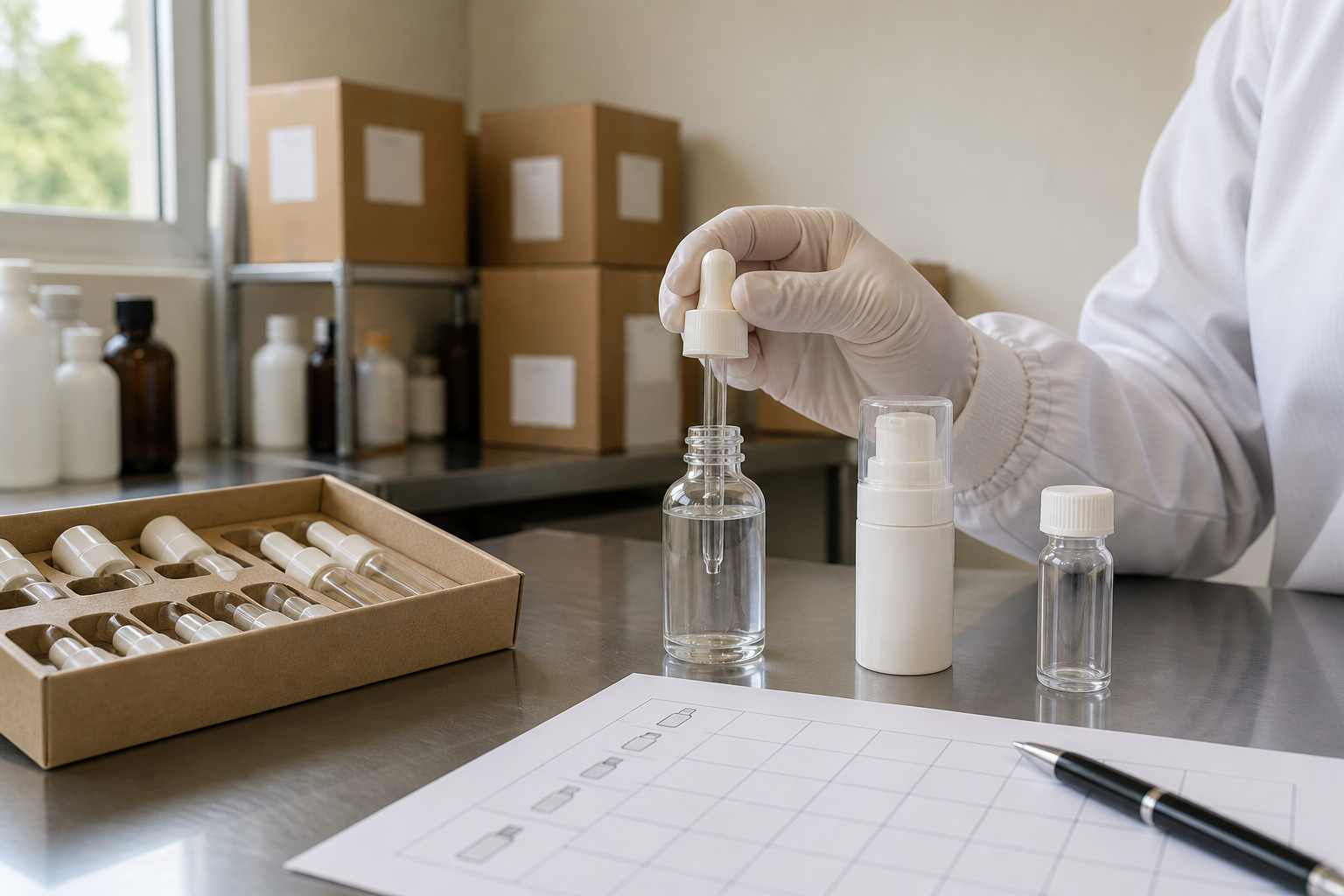
Direct answer: precision-dispensing packaging is not a formula claim. A new controlled-dose or auto-loading dropper creates a useful sampling question: can the selected dispenser repeatedly load and deliver the buyer’s actual serum while keeping the outlet, closure, label, carton, and transport plan practical? Buyers should compare the mechanism with an ordinary dropper, an airless pump, and a trial vial before locking artwork or quotation.
What changed, and why it matters to OEM buyers
On 20 July 2026, packaging supplier Aptar Beauty announced the first commercial use of its NeoDropper Autoload technology on Dermalogica’s FutureCode Booster. Aptar describes a twist-and-push system, automatic applicator loading, a short applicator, and a dip tube intended to support controlled dispensing and formula use. The retail product page separately confirms that the commercial pack uses a glass bottle, mixed-material pump/dropper, and paper carton.
Those are verifiable facts about one commercial launch. They do not prove that the mechanism fits another serum, that every dose is identical under every condition, that the complete pack is recyclable, that product residue is eliminated, or that the package meets a buyer’s market requirements. For a private label project, the useful development signal is the need for a more disciplined dispenser comparison—not a reason to copy the source formula, claims, name, colors, images, or package geometry.
Verified facts
A dated supplier announcement records a first commercial auto-loading dropper launch. The supplier explains the intended loading and dispensing sequence. The brand’s public product page confirms commercial use and identifies broad package materials.
GUOCUI factory-side inference
OEM buyers can turn the event into a filled-sample comparison covering viscosity, loading, dose preference, residue, closure fit, assembly, label area, carton protection, and supplier documentation.
Not claimed
GUOCUI does not claim demand growth, sales performance, clinical superiority, formula preservation, hygiene, dose accuracy, low waste, recyclability, legal compliance, or availability from a particular component supplier.
10 September update: measure airless claims on the filled pack
Source date: 10 September 2026. Amcor states for Magic One: 0.3 mL output at any angle, 96% restitution, a lockable pump, and formula protection. Its 16–17 September show was still ahead, so no event, order, or demand result is claimed.
Verified supplier statements
These figures and functions describe Amcor’s component only.
GUOCUI factory-side inference
Fix formula, fill, lot, orientation, restart state, and method before comparing filled-pack criteria.
Not claimed
GUOCUI has not sourced or tested this component. No supplier figure, compliance, availability, MOQ, price, or lead time is a GUOCUI offer.
| Supplier statement | Filled-pack question | Buyer acceptance record |
|---|---|---|
| 0.3 mL output at any angle | Does the formula meet target after orientation changes and restart? | Record versions, method, range, variation, and instructions. |
| 96% restitution | What remains unavailable at the stop condition? | Record fill, output, residue, exclusions, stop rule, and result. |
| Lockable pump | Does the lock resist accidental actuation in handling? | Record lock, leakage, collar, carton, and restart observations. |
| Formula protection | Does the complete filled pack remain compatible? | Plan compatibility, stability, dispensing, sensory, mass-loss, and microbiological checks. |
A practical precision-dispensing sample matrix
| Decision | What the buyer should specify | What the sample team should observe |
|---|---|---|
| Formula flow | Watery essence, light gel serum, cushion serum, or light emulsion; appearance and fragrance direction | Loading behavior, interrupted flow, visible bubbles, outlet residue, and changes after repeated handling |
| Dose experience | Drop-by-drop control, one actuation, mixing with another product, or direct facial application | Repeatability across filled samples, user force, drip-back, stray drops, and whether the use instructions remain simple |
| Container and closure | Bottle material, fill range, closure style, applicator length, cap profile, and decoration area | Assembly fit, cap engagement, leakage observation, contact points, and pack stability during normal use |
| Artwork and secondary pack | Logo file, label languages, carton structure, inserts, channel requirements, and shipping country | Label alignment, rubbing risk, required text area, carton fit, movement protection, and packing sequence |
| Evidence boundary | Requested component specification, material description, supplier declarations, and market-review checklist | Which exact files are available, which claims remain unsupported, and which questions need a qualified local reviewer |
Formula positioning should remain separate from the packaging signal
The commercial launch is tied to a branded longevity serum with proprietary naming, detailed actives, DNA-related language, in-vitro performance wording, a fixed price, and retail claims. None of that transfers automatically to an OEM brief. A GUOCUI project can instead begin with a conservative hydration-support, antioxidant-positioned, peptide-positioned, fermented-ingredient, niacinamide-care, or fragrance-free direction. The exact formula, percentages, INCI list, claims, test plan, and destination-market language must be confirmed later.
The buyer can still use skin longevity as a high-level product-planning term when the public wording stays cosmetic and evidence-led. It should guide questions about comfortable long-term routine use, barrier-supportive positioning, packaging usability, and consistent sample evaluation. It should not become a promise to repair DNA, reverse aging, regenerate tissue, or reproduce another company’s proprietary complex.
Clean-room design-around: what GUOCUI removed
The public GUOCUI direction removes the supplier and retail brand names from the product page, the proprietary mechanism and formula names, the source bottle shape, grey campaign styling, advertising images, exact ingredients, percentages, price, clinical and DNA-related claims, consumer-review totals, and every source pixel. The original article keeps the companies only as linked news subjects so readers can audit the event.
The development direction is intentionally neutral: compare generic controlled-dose, standard dropper, compact airless, and sample-vial routes. Change the formula concept, component family, color system, artwork, carton, channel, and QC plan around the buyer’s brief. A component supplier’s own intellectual-property and availability terms must still be checked before selection.
What to send before GUOCUI requests components
- Target market, sales channel, and responsible party for final label and legal review.
- Serum positioning, texture, appearance, fragrance preference, and ingredient restrictions.
- Preferred dose experience, fill range, bottle material, dropper or pump route, and trial quantity.
- Logo status, label languages, decoration preference, carton structure, and set-box needs.
- Estimated order quantity range, target sample window, launch timing, and shipping country.
- Any required component specification, material, compatibility, transport, or supplier-document checklist.
Quotation depends on formula, packaging components, quantity, decoration, label, carton, requested checks, and shipping plan. Sample and production timing can be confirmed only after the formula and component route are reviewed.
FAQ
Does a self-loading dropper guarantee a consistent dose?
No. A supplier may describe an intended mechanism, but the buyer should review the exact filled sample, formula flow, use sequence, component tolerances, and repeatability before making a claim.
Is a controlled-dose dropper better than an airless pump?
Not universally. A dropper may support a visible ritual and adjustable amount; an airless pump may offer a different handling and outlet experience. The right route depends on texture, channel, dose preference, artwork, cost, component availability, and testing.
Can GUOCUI copy the commercial launch?
No. The source launch is research evidence. A GUOCUI project must use a different formula brief, generic or separately sourced components, original visuals, new artwork, conservative claims, and a buyer-specific QC plan.
Does PPWR make this package EU compliant?
No. Regulation (EU) 2025/40 generally applies from 12 August 2026, but obligations and dates vary. Exact responsibilities and claims depend on the package, role, market, and supporting documentation.
Which GUOCUI product page should buyers use as a starting point?
Use the Facial Serum Packaging Component Review Program, then send the formula, dose preference, component, artwork, quantity, and market details through the inquiry path.
Sources and evidence boundary
- Aptar Beauty, first commercial auto-loading dropper announcement, 20 July 2026
- Aptar Beauty, mechanism product page
- Dermalogica, commercial product page and broad package-material disclosure
- Amcor, facial-skincare airless packaging supplier announcement, 10 September 2026
- EUR-Lex, Regulation (EU) 2025/40
- European Commission, packaging-waste overview and application date
Short conclusion: the defensible trend is not a promise that one dispenser is superior. It is a better OEM sampling discipline: lock the buyer’s use case first, compare filled components, record open evidence, and connect formula, dispenser, artwork, carton, QC, quotation, and destination-market review before publication.
Review the product catalog, the serum packaging starting point, and customization options. Then send the target market, formula texture, dispenser preference, quantity range, artwork status, and sample window.
8 October buyer action: connect dispensing records to coverage
Direct answer: dispenser output and skin coverage answer different questions. Before a hydrating serum is described for broad use, local use or a second local layer, record the intended zone, portion actually applied and interval between portions. The same total mass over different areas is not an equivalent use condition.
Evidence boundary: this addition was checked on 8 October 2026. The 2 October issuer announcement linked below describes two gel-serum SKUs with broad and local-use positioning; one also mentions repeat application. It was already present in the 5 October trend report. This addition introduces a buyer sampling action, not a newly discovered launch, verified fulfilment or demand increase. The historical supplier facts and dates above remain their original evidence.
Verified facts, factory-side inference and not claimed
Verified facts: the issuer’s dated announcement distinguishes two formulas and describes tube dispensing and use routes. FDA background identifies safety substantiation and packaging or consumer handling as relevant considerations. These sources do not establish a GUOCUI dose or protocol.
GUOCUI factory-side inference: compare texture revisions within one recorded use route, or compare use routes while holding the formula revision fixed. Keep dispenser output, transfer loss, applied portion, defined area, each added portion and cumulative mass identifiable. If the area or applied mass cannot be measured reliably, mark mass per unit area unavailable. Link the record to the formula code, dispenser revision, next routine step and artwork brief.
Not claimed: this action does not adopt the source brands, formulas, ingredient concentrations, claims, tube shape or candy-like artwork. It does not establish improved hydration, penetration, eye-area suitability, precise dosing, sterility, unlimited reapplication or a validated test method.
Three questions before the label wording is chosen
Does an equal dispenser output make local and full-face use equivalent?
No. Record the portion actually applied, the area and distribution. Product remaining on an outlet or transfer tool does not automatically belong in the applied mass.
How should a second local layer be reviewed?
Identify its added portion, cumulative mass, surface condition and actual elapsed interval separately, while keeping the next routine step consistent.
Can these records establish consumer instructions?
No. They support a buyer sampling discussion. Final directions, claims, safety assessment and any validated methods require review for the actual formula, use and destination market.
Sources for this action
- Momotani Juntenkan issuer announcement, 2 October 2026: two specific gel-serum definitions and use-route wording; current fulfilment, full INCI and natural momentum remain unverified.
- FDA product-testing overview, read 8 October 2026: safety-substantiation background; no universal GUOCUI sampling protocol.
- FDA microbiological-safety overview, read 8 October 2026: packaging and handling considerations; no approved nozzle-cleaning method.
Use the GUOCUI hydrating serum coverage review as the existing catalog starting point. Browse Products and the Trend Center, then review Customization and send the market, use map, sample codes and packaging brief. MOQ, quotation and timing remain subject to project review.
14 October Buyer Action: Match the Component Map to the Ingredient Record
Direct answer: a serum reference needs two evidence records before artwork or quotation is fixed: one identifying the packaging parts and one identifying the supplied ingredient inputs. A decorative cap does not establish the liquid-contact material. An ingredient headline does not establish its exact form, supplied carrier or percentage basis. Keep both records linked to the proposed sample revision.
Evidence boundary: reviewed on 14 October 2026. This addition responds to company-source serum planning material and adds a buyer handoff action. It does not report a new public launch, completed delivery, demand increase or GUOCUI test result. The supplier announcement below is dated 17 September; the FDA pages are background resources. Historical facts and dates elsewhere in this brief remain separate.
Verified Facts
Aptar’s 17 September pump announcement identifies a polyolefin component system, makes recycling statements conditional on compatible bottles and recommends compatibility testing. It also limits transport-test interpretation to the relevant container and formula. This is supplier evidence about its own component, not approval for a GUOCUI serum.
FDA’s ingredient-naming overview addresses identifying ingredients on cosmetic labels. Its product-testing overview distinguishes available ingredient information from the assessment needed for a finished product. Neither page verifies a source illustration, serum formula or proposed component.
GUOCUI Factory-Side Inference
For a hydrating serum, ask which parts are decorative and which contact the formula during filling, storage and dispensing. Keep the shell, bottle, closure, seal and relevant dispensing parts identifiable. Request declarations for a wood-look finish before selecting material or environmental wording. An ordinary dropper and a pump should each retain their own component reference.
For a vitamin-C-led serum, record the exact form and supplied presentation of every proposed co-antioxidant. Keep the supplier identity, carrier, technical document and any declared assay basis together. A blend addition is not automatically the same percentage of its named ingredient in the final formula. Do not infer a two-phase architecture from three ingredient names or combine unrelated percentages into one headline.
The practical quotation branch is whether the buyer wants a simpler documented route now or an additional component or ingredient option after its gaps are resolved. Track those options separately rather than treating every attractive reference detail as an approved requirement.
Not Claimed
No source percentage, complete INCI, capacity, wood or bamboo composition, cruelty-free status, recyclability, clinical outcome, stability result or supplier availability transfers to GUOCUI. These are proposed review records, not validated methods or completed sampling. MOQ, quotation, sample timing and production timing remain subject to formula, packaging and order-plan review.
Does a Packaging Appearance Prove Its Contact Materials?
No. Identify the decorative parts and the formula-contact assembly from the actual component documents.
Does a Three-Ingredient Headline Approve a Serum Formula?
No. Confirm each supplied material, its basis and the proposed formula architecture before artwork or public claims are approved.
Review the hydrating-serum component handoff and vitamin C serum ingredient handoff. Browse the Trend Center and Products, review Customization, then send the component references, ingredient documents and open questions.
Leave a Reply