
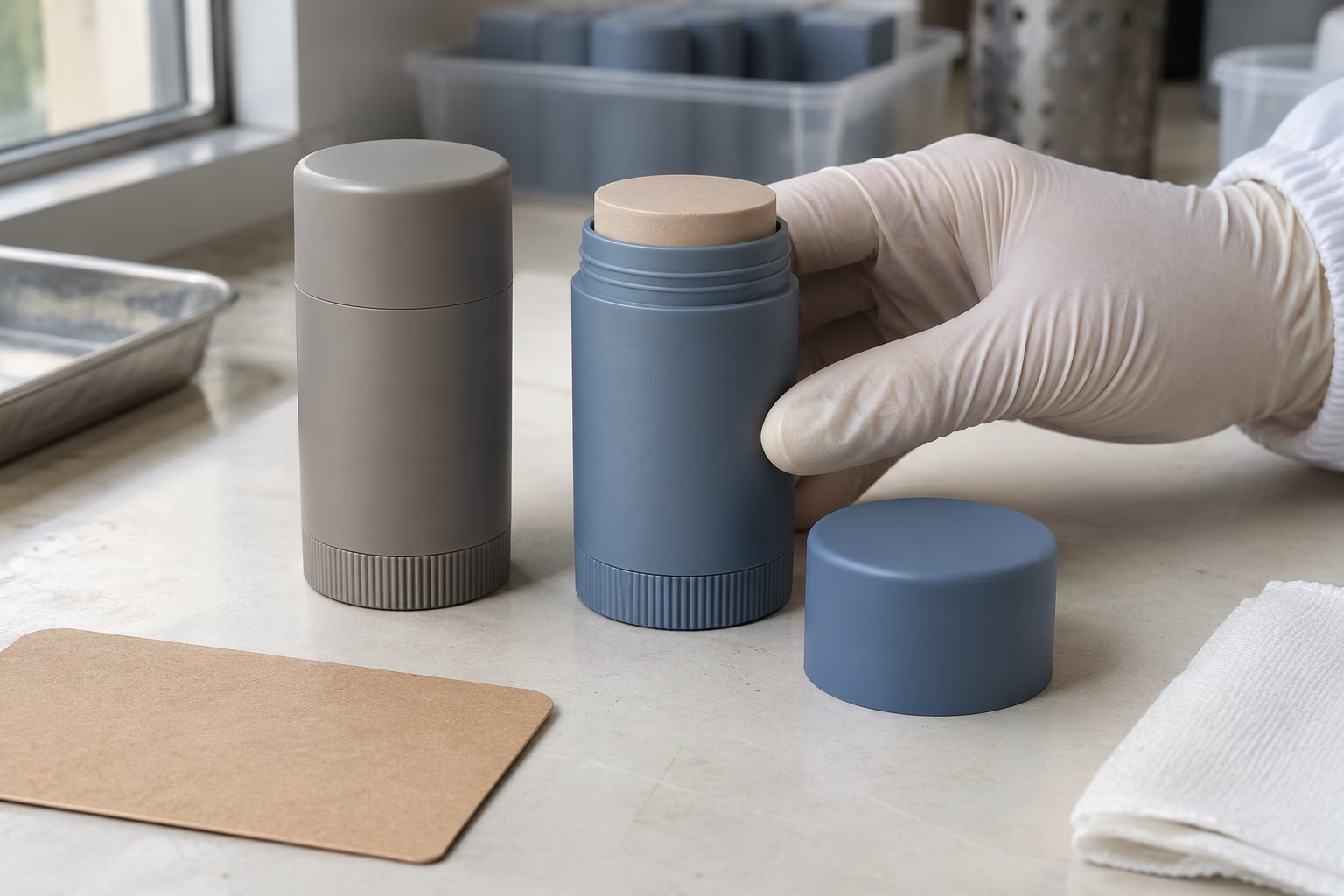
Direct answer: Review a filled twist-up mask stick with its intended formula, mechanism and cap assembled together. Check whether the stick advances, retracts and applies consistently, then check the cap again after repeated use and agreed storage. An empty package can help you choose a shape and finish; it cannot show whether the filled stick will stay seated, clear the cap or leave the intended layer on the skin.
What counts as a filled twist-up sample?
A filled twist-up sample is a trial of the proposed solid or semi-solid mask formula in a working package. It includes the body, rotating mechanism, cup that holds the formula and closure. The sample record should identify the formula revision, component codes, intended net content and how the unit was filled. A component swatch or an empty pack is a separate reference. A hand-filled sample can be useful early on if everyone records how it differs from the proposed production fill.
Before sending feedback, identify the proposed use. A buyer developing a rinse-off facial mask may want the product to lay down a visible, even film across a cheek-sized area. A travel-focused brand may also care how easy it is to close the pack cleanly. Write down the expected application and removal experience so the team can tell which issues belong to the formula and which belong to the package.
Run the same checks on each sample
| Check | What to observe | What to send back |
|---|---|---|
| First opening | Look for product on the inside of the cap, the rim or the collar before use. | Photo of the unopened unit and the cap immediately after opening. |
| Advance and retract | Raise the stick only to the agreed working height. Note wobble, scraping, slipping or an uneven return. | Short video showing the base turning and the stick moving in both directions. |
| Application | Use the agreed test surface and method. Note drag, crumbling, uneven transfer or a change as the sample warms during handling. | Side-by-side results under the same light, with sample IDs and the number of passes. |
| Recap | Retract and close the cap. Reopen it and check for a fresh contact mark or residue around the neck. | Photo of the position before recapping and the inside of the cap afterward. |
| Repeat review | Repeat the agreed checks after the specified storage and handling conditions. Compare with a retained reference. | Storage orientation, date, conditions and the point at which any behavior changed. |
Keep the comparison practical. If one sample uses a different cup and a different formula, a cleaner cap does not tell you which change helped. Where possible, change one variable at a time and preserve a labeled reference. If a new formula or mechanism is essential, record the revised pair as a new sample and run the relevant checks again.
Use the failure to decide what to change
The stick smears the cap
First establish when the smear appears. Product present before the first opening calls for a different investigation than a mark that appears only after recapping. Share the filled height, position after retraction and a picture of the inside of the cap. That gives the sample team a starting point for checking clearance, whether the stick is retracting fully and whether handling changed its position.
The dial turns, but the stick moves unevenly
Record whether the issue happens on the first turn, near the working height or only on retraction. Ask the team to compare the suspect unit with a second unit of the same revision. Check whether the formula remains seated in the cup and whether the issue appears with the empty mechanism too. An empty comparison can help isolate a mechanical issue; the next decision still depends on the filled assembly.
The pack operates, but the layer is patchy
Agree what an acceptable layer looks like before requesting a formula change. A short video of the first pass and a photo after the agreed number of passes are more useful than “too dry.” Record the surface and how the sample was conditioned. For a rinse-off format, discuss how to evaluate removal separately from how smoothly the stick applies. The observations describe the sample experience; they do not establish product efficacy.
What to send with a quotation request
- Target market, sales channel, planned use and desired layer or finish.
- Estimated order quantity, target net content and your preferred pack shape or reference dimensions.
- Whether you are supplying the component, choosing from available options or asking to compare mechanisms.
- Artwork languages, decoration direction, label and carton needs, and whether individual or set packing is planned.
- One named person to review samples and a short list of the checks that must pass before artwork approval.
GUOCUI BIO TECH / Guangzhou Guocui Biological Technology Co., Ltd. can discuss the brief as a Private Label, OEM, ODM or Custom Formula project. Use Products and the facial mask catalog to explore formats, then review customization options and send the project brief. MOQ, quotation, sample scope and production timing depend on the proposed formula, packaging and order plan. The sample approval checklist covers the broader artwork and production handoff.
Frequently asked questions
Can we approve the component before the formula is finalized?
You can shortlist the shape, decoration and general handling using empty components. Confirm working height, retraction, cap clearance and application using a representative fill before approving the full combination.
Does a matching diameter mean we can switch package suppliers?
A similar diameter does not establish interchangeability. Compare the drawing, cup, travel, closure and fill method. Review the affected checks on the new filled unit before accepting the change.
How many twist cycles should a sample pass?
There is no universal cycle count in this guide. Agree a method, number of cycles, conditions and acceptance criteria for the chosen package and intended use, then record what was tested.
Packaging references
Aptar Beauty face stick packaging and the HCP Packaging dial stick product sheet illustrate different component options and filling configurations. These are packaging background references. The checks above are GUOCUI’s suggested buyer review, and supplier examples do not confirm component availability or fit for a particular project.