
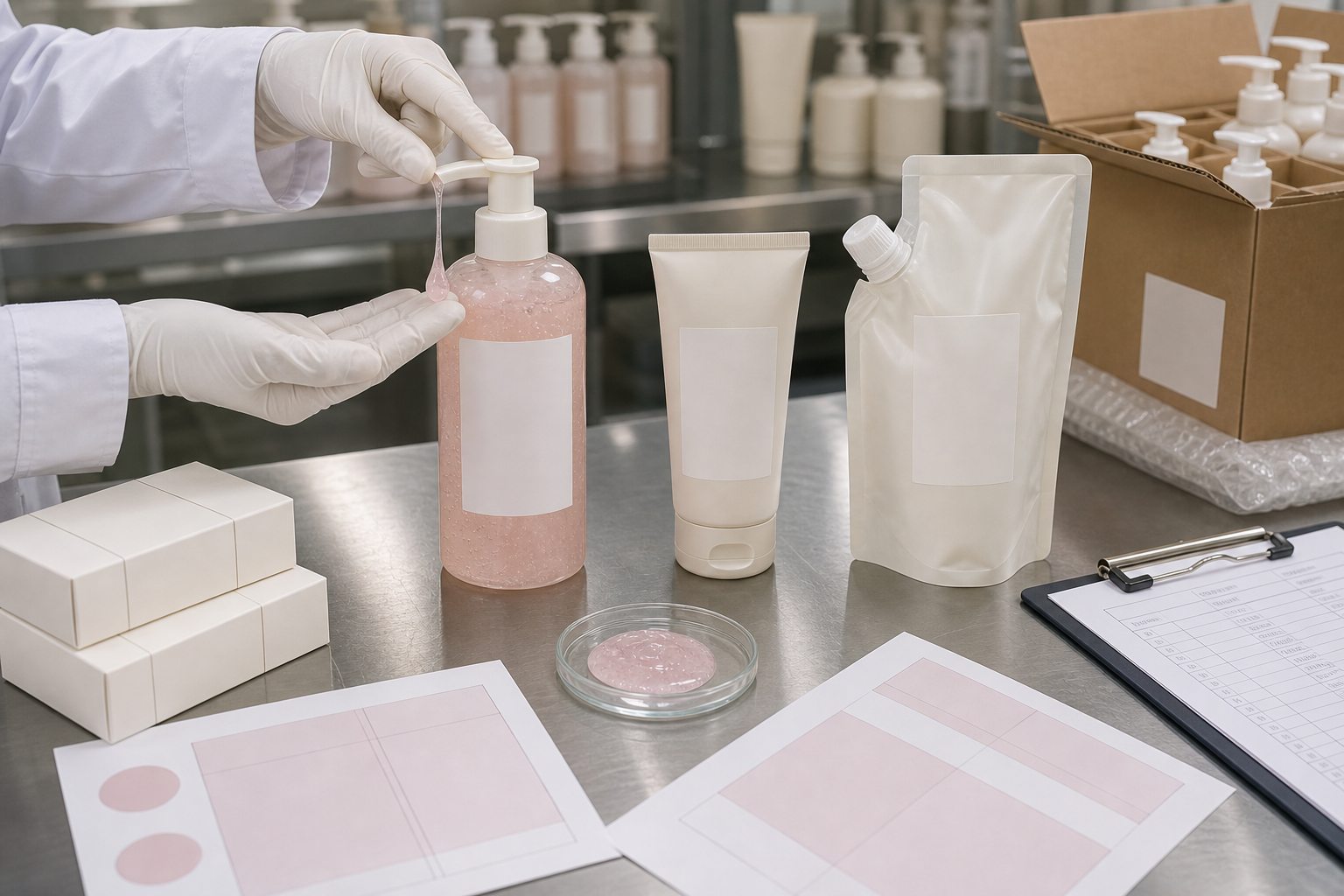
E-Commerce Skincare Packaging Must Be Proven as a Filled System
Direct answer: a closure described as e-commerce-ready is a useful starting point, but it is not approval for a private label skincare SKU. The factory and buyer still need to test the actual formula, bottle, neck finish, closure, liner or seal, label, secondary pack, shipping carton, and fulfillment route as one filled packaged-product. A different viscosity, bottle wall, torque setting, headspace, decoration, or carton can change leakage and damage performance.
This distinction matters for online beauty sellers because the package is handled many times before the buyer opens it. It may be stored on its side, exposed to temperature changes, dropped inside an over-box, compressed beside other items, or opened after pressure has built around the closure. GUOCUI BIO TECH / Guangzhou Guocui Biological Technology Co., Ltd. uses supplier information as an engineering input, then brings the real filled sample back into formula-package review, packing checks, and buyer approval.
What a Closure Claim Does and Does Not Prove
A July 2026 supplier announcement introduced several closures positioned for e-commerce and reported Amazon ISTA-6 robustness testing at portfolio level. That is relevant market evidence, but it does not prove a GUOCUI buyer’s final combination. ISTA guidance is explicit that test procedures apply to a specific packaged-product system, not an individual packaging material in isolation. It also recommends retesting when the product, package, or process changes.
| Evidence available | What it can support | What remains open |
|---|---|---|
| Closure supplier specification or prior test | Shortlisting, component questions, sample request, and preliminary risk review | Performance with the selected formula, bottle, torque, seal, decoration, carton, and route |
| Empty package fit check | Thread engagement, cap alignment, label area, appearance, and basic operation | Leakage, paneling, stress cracking, residue, pressure response, and filled weight behavior |
| Filled pilot sample | Formula compatibility, dispensing, closure cleanliness, and early handling checks | Production consistency, packed-product transport performance, and approved change control |
| Route-appropriate packaged-product test | Evidence for the tested SKU, pack configuration, and documented conditions | Any later material, component, formula, fill, carton, or process change |
Six Checks Before Approving E-Commerce Skincare Packaging
1. Freeze the exact formula and fill condition
Record viscosity, density, oil and surfactant direction, pH where relevant, fill temperature, target fill weight, headspace, and any settling or phase behavior. A water-thin toner, gel cleanser, body wash, cream, and oil do not load the same closure in the same way. Use production-representative samples rather than water-filled demonstration bottles.
2. Match the bottle neck and closure specification
Confirm the neck finish, thread, sealing land, dip tube or orifice, liner or plug, cap material, bottle material, and supplier drawing revision. Ask which torque range and assembly method the closure expects. A visually compatible cap is not enough if the thread, sealing surface, or application torque differs.
3. Test dispensing and residue after real use
Check first opening, priming, dose, flow, cutoff, stringing, clogging, cap contamination, and one-handed use. Repeat after the sample has rested in different orientations. The goal is not only to prevent obvious leakage; it is also to confirm that the package remains clean and understandable after repeated consumer use.
4. Challenge the filled primary pack
Use a documented plan for upright, side, and inverted storage; temperature exposure; pressure or vacuum where relevant; vibration; impact; and post-test opening. Inspect the seal area, thread, label, pump or cap, bottle panels, and product appearance. The exact method should match the product risk, target market, fulfillment route, and any retailer or carrier requirement.
5. Test the retail unit inside its shipping configuration
Add the real carton, insert, protective material, over-box, orientation, unit count, and shipping weight. Inspect scuffing, cap impact, accidental opening, label damage, carton collapse, and product movement. Testing a closure by itself cannot reveal whether another item in the parcel presses directly on the cap.
6. Create a retest trigger list
Retest or formally review changes to the formula, fragrance, colorant, fill weight, headspace, bottle resin, neck finish, closure resin, liner, supplier, torque, label, carton, insert, unit count, packing method, or fulfillment route. The approved sample and test report should identify the exact revision tested so a later substitution is visible.
Buyer Handoff Checklist for OEM Quotation and Sampling
Buyer handoff checklist: send enough information for the factory to price the right package and plan the right sample, not just a bottle screenshot.
- Product format, texture or viscosity direction, target fill size, and fragrance or color requirements.
- Target country, Amazon or other sales channel, fulfillment route, parcel configuration, and any retailer test requirement.
- Preferred bottle, cap, pump, disc top, flip top, liner, seal, refill, carton, and protective-pack direction.
- Estimated quantity, artwork status, label languages, barcode space, decoration method, and individual-carton plan.
- Known leakage complaints, acceptable test scope, sample deadline, launch timing, and who approves package changes.
MOQ and quotation depend on formula, components, decoration, quantity, label requirements, testing, packing, and shipping plan. Sample and production timing can be confirmed after component availability, formula-package fit, artwork readiness, test scope, and revision ownership are reviewed. GUOCUI does not use one fixed number or lead-time promise for every custom e-commerce project.
Factory and QC Records Buyers Should Expect
A practical handoff can include the approved formula and filled sample reference, component supplier and drawing revision, incoming package checks, application settings, fill and assembly record, leakage or compatibility observations, artwork version, packed-unit configuration, deviation notes, and release owner. The exact record set depends on the project, but every important claim should point back to the tested configuration.
The useful conclusion for overseas buyers is short: supplier evidence helps choose a component; packaged-product evidence approves a SKU. Keep those two layers separate, and re-open the test decision whenever a material change appears.
Frequently Asked Questions
Does an e-commerce-ready closure guarantee no leakage?
No. It indicates a design direction or prior evidence boundary. The buyer’s filled formula, bottle, closure, assembly settings, secondary pack, shipping configuration, and route still need project-specific review and testing.
Can GUOCUI use a buyer-selected pump or cap?
GUOCUI can review a buyer-selected component, but feasibility depends on the exact formula, bottle neck, supplier specification, sample availability, decoration, filling process, test plan, quantity, and destination requirements.
When should a private label skincare package be retested?
Retest or formally reassess when the product, package, process, or distribution route changes in a way that may affect performance. Track formula, component, material, supplier, torque, fill, carton, insert, packing, and route revisions.
What should an Amazon beauty seller send before quotation?
Send the product format, target size, formula direction, package concept, fulfillment route, individual and shipping-pack configuration, estimated quantity, artwork status, test requirement, and launch window.
Continue the GUOCUI Packaging Conversation
Browse the GUOCUI product catalog, review Body Care starting points, compare the fine-mist pump compatibility checklist and hygienic cream packaging checks, see Customization and Private Label support, or send a packaging brief to the GUOCUI export team.
Source Context
Leave a Reply