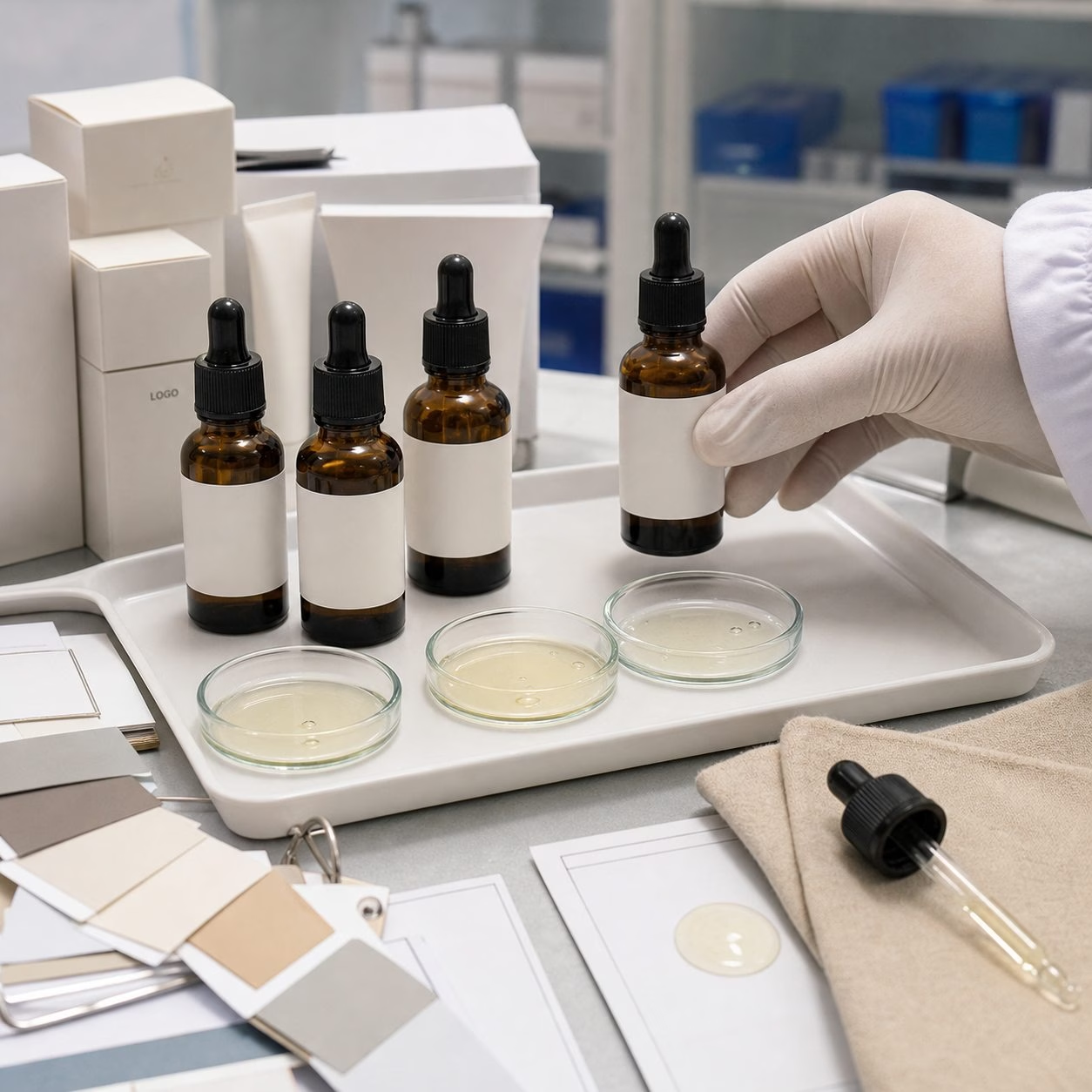
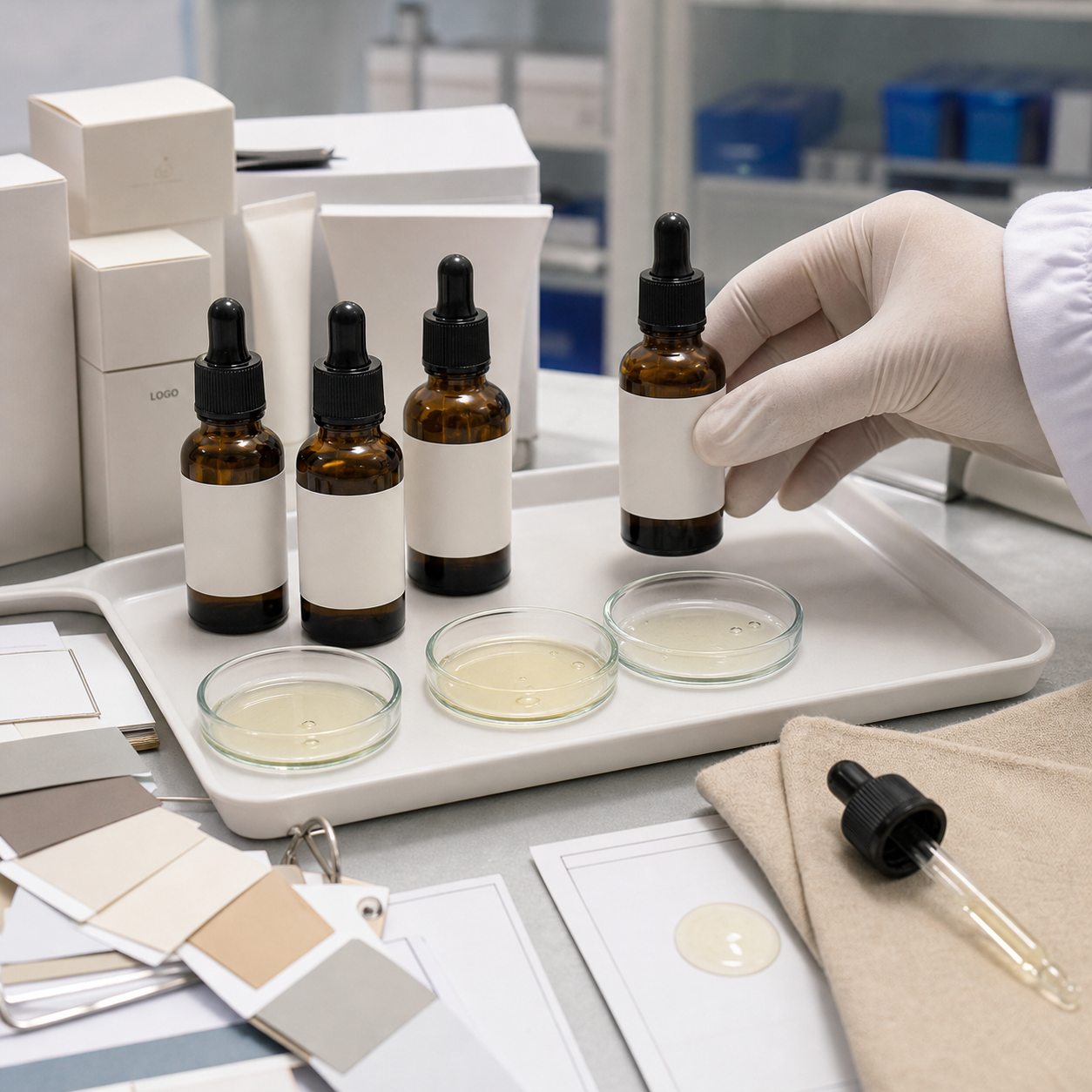
Direct answer: a useful retinoid serum OEM brief does not begin with the biggest percentage on a trend page. It begins with the exact ingredient identity, the supplier raw-material composition, the active-content basis behind any number, the destination market, the intended claims, and the package and stability plan. Without those records, two products that both say “retinoid” or show the same headline percentage may be technically and commercially different.
Recent launch monitoring in late July 2026 reinforced this buyer problem: a headline number may describe the input level of a multi-component supplier blend rather than the percentage of one pure retinoid. That distinction should be resolved inside the RFQ and sample specification, not left for label artwork. GUOCUI BIO TECH / Guangzhou Guocui Biological Technology Co., Ltd. treats the number as the end of a documentation chain, not the start of a marketing promise.
Why “What Percentage Is It?” Is Not a Complete OEM Question
A percentage can refer to pure active, a diluted solution, a carrier blend, an encapsulated material, or the total addition rate of a supplier product. The factory needs the commercial raw-material name, complete INCI, active assay or standardization basis, carrier system, recommended conditions, and supporting TDS, SDS, CoA, stability, handling, and market-use documents. A buyer-facing percentage should never be inferred from the raw-material name alone.
| Buyer wording | Factory clarification | Decision it affects |
|---|---|---|
| “7% retinoid” | Seven percent of what exact supplied material, with what active assay and carrier? | Formula calculation, artwork, claims, and cost comparison. |
| “Gentle retinol alternative” | What is the exact INCI and what evidence supports the comparison in the target market? | Claim language, safety review, and buyer education. |
| “Night serum” | What texture, use amount, routine position, packaging, and warning copy are intended? | Sample brief, package format, instructions, and label area. |
| “Suitable worldwide” | Which countries and channels are actually in scope? | Ingredient review, notification, artwork, language, and launch timing. |
1. Lock the Ingredient Identity and Active-Content Basis
Before sampling, record the exact INCI route being considered. Retinol, retinal, retinyl esters, hydroxypinacolone retinoate, and supplier blends should not be collapsed into one interchangeable ingredient label. Ask the supplier or formulator to identify the material, carrier, assay, recommended use range, storage conditions, light or oxygen sensitivity, incompatibilities, and documentation version.
Create one calculation sheet that separates raw-material addition rate from active-equivalent or assayed content. Keep that sheet internal until the final formula, evidence and destination-market review support a public number. This prevents a supplier blend percentage from becoming an exaggerated product claim.
2. Define the Destination Market Before Formula and Artwork
Regulatory scope changes the project. For example, Commission Regulation (EU) 2024/996 sets Retinol Equivalent limits and a required warning for products containing Retinol, Retinyl Acetate or Retinyl Palmitate. The regulation identifies 0.05% RE for body lotion and 0.3% RE for other leave-on and rinse-off products, with transition dates for non-compliant products. The underlying SCCS opinion explains the consumer-exposure reasoning.
Those provisions name specific vitamin A substances. They should not be casually copied onto a different retinoid identity, and a different identity should not be assumed exempt or approved. Confirm the exact ingredient and seek destination-market regulatory review. A buyer should send target countries, channels, age positioning, planned claims, label languages and any restricted-ingredient policy before the sample formula is locked.
3. Choose Packaging for the Actual Formula
“Use an amber dropper” is not a complete packaging decision. Review the formula against the bottle or airless system, closure, gasket, wiper, dip tube, headspace, fill method, decoration and secondary carton. Light control, oxygen exposure, repeated opening, dose repeatability, component contact and e-commerce handling all matter.
- Compare opaque, amber, coated or airless directions only after the formula route is known.
- Check whether the closure and decoration remain acceptable after storage and handling.
- Record fill appearance, odor, color and dispensing against an approved reference.
- Retest when the formula, bottle, pump, closure, supplier, decoration or fill process changes.
4. Build a Stability and Compatibility Matrix, Not One Shelf Photo
A first sample can look attractive and still be a weak production reference. The project team should define appropriate stability, package compatibility and microbiological work for the actual formula and market plan. Record controlled checkpoints for appearance, odor, color, separation, viscosity or flow, pH where relevant, package interaction, leakage, dispensing, closure fit and label condition.
Do not promise a universal timeline before the formula and package route are reviewed. Sample and production timing depends on raw-material availability, sample revisions, packaging samples, testing plan, artwork readiness and destination requirements. MOQ and quotation can be confirmed after formula, packaging, quantity, label requirements and order-plan review.
5. Separate Cosmetic Positioning from Medical or Guaranteed Claims
A private label night serum can be positioned around texture, routine fit, mature-skin care, smoother-looking or refined-looking skin, and a buyer-defined cosmetic story when the formula and evidence support the wording. Avoid acne-treatment, prescription-comparison, pregnancy-safe, peeling-guarantee, wrinkle-removal or clinical-result claims without the required substantiation and specialist review.
Usage copy also needs a real owner. Decide who prepares directions, precautions, patch-test language, routine order and market-specific warnings, and who approves the final version. The factory, buyer and regulatory reviewer should not assume another party has completed this step.
Buyer Handoff Checklist Before Retinoid Serum Sampling
- Target countries, sales channels, buyer type and planned launch window.
- Exact retinoid or vitamin A direction, ingredient restrictions and supplier-document expectations.
- Desired texture, finish, fragrance position, routine role and compatible support ingredients.
- Packaging preference, capacity direction, light and oxygen strategy, decoration and carton needs.
- Estimated quantity, sample deadline, artwork status, label languages and claim boundary.
- Testing, notification, documentation and shipping requirements for the intended market.
Frequently Asked Questions
Does a higher retinoid percentage automatically mean a stronger serum?
No. The number may describe a pure active, a diluted material or the addition rate of a multi-component supplier blend. Compare exact identity, assay, carrier, formula level and evidence before comparing percentages.
Can a buyer choose between retinol, retinal and HPR in one brief?
They can be discussed as separate development routes, but they should not be treated as interchangeable. Each route needs its own supplier documents, formulation plan, stability work, packaging review and market assessment.
Is amber glass always the best package?
No. Amber glass may help one project, while an opaque or airless system may suit another. The final package should be tested with the actual formula, closure, fill process and shipping plan.
Can GUOCUI confirm MOQ and lead time before the formula is selected?
Only a provisional discussion is possible. MOQ, quotation, sample timing and production timing depend on formula, components, decoration, quantity, testing, artwork and order-plan review.
What should be approved before bulk production?
Approve the formula and reference sample, raw-material identity records, package and compatibility results, artwork, instructions and warnings, QC checkpoints, coding areas, carton plan, documents and shipping requirements.
Start a Documented Retinoid Serum OEM Brief
Browse the GUOCUI B2B product catalog, review the Private Label Retinal Night Facial Serum direction, compare the serum stability and packaging handoff guide, see Customization and Private Label support, or send a documented serum brief to the GUOCUI export team.
Regulatory context: review the official Commission Regulation (EU) 2024/996 and the SCCS revised opinion on vitamin A. This article is a B2B project-planning guide, not legal, medical or formula approval.
Leave a Reply