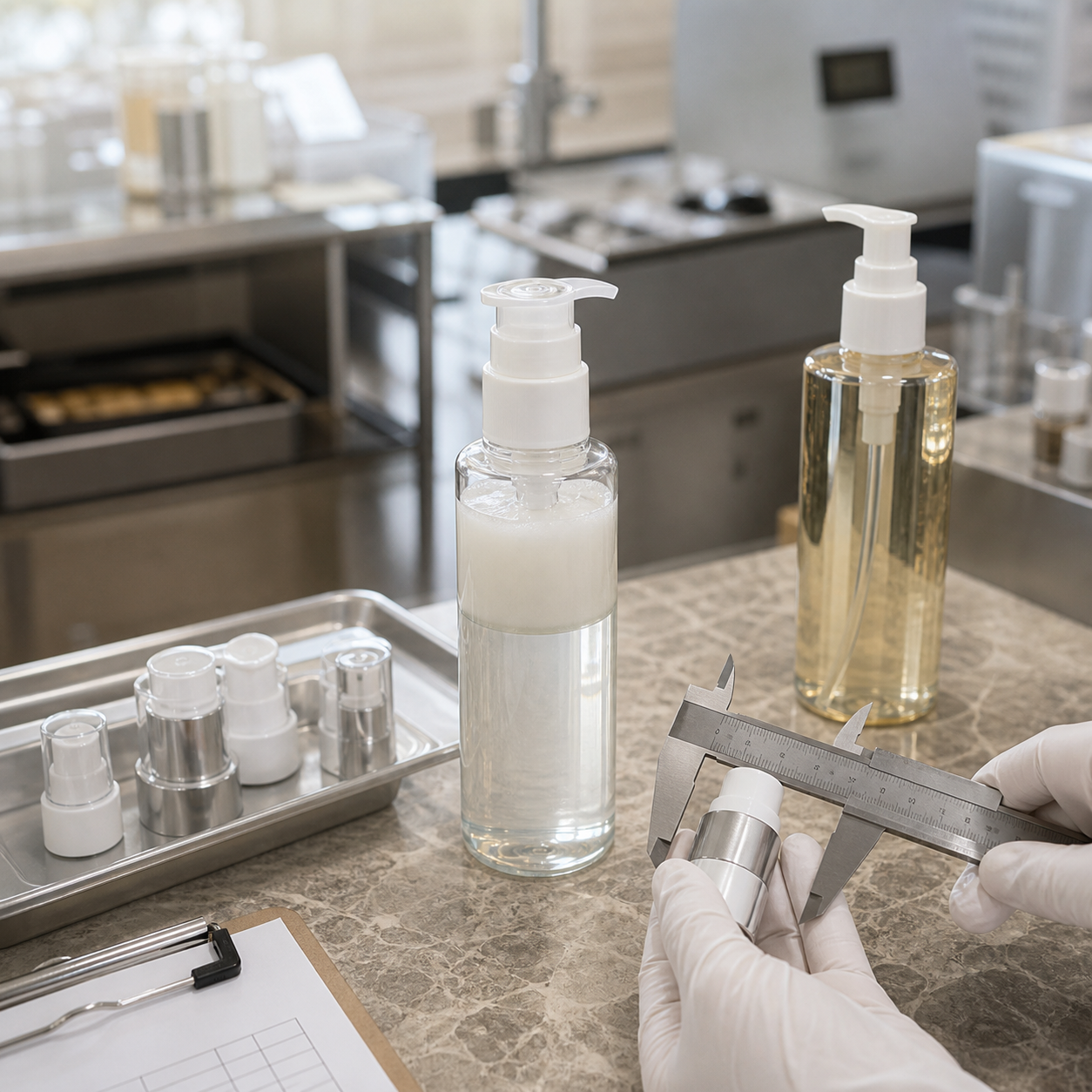
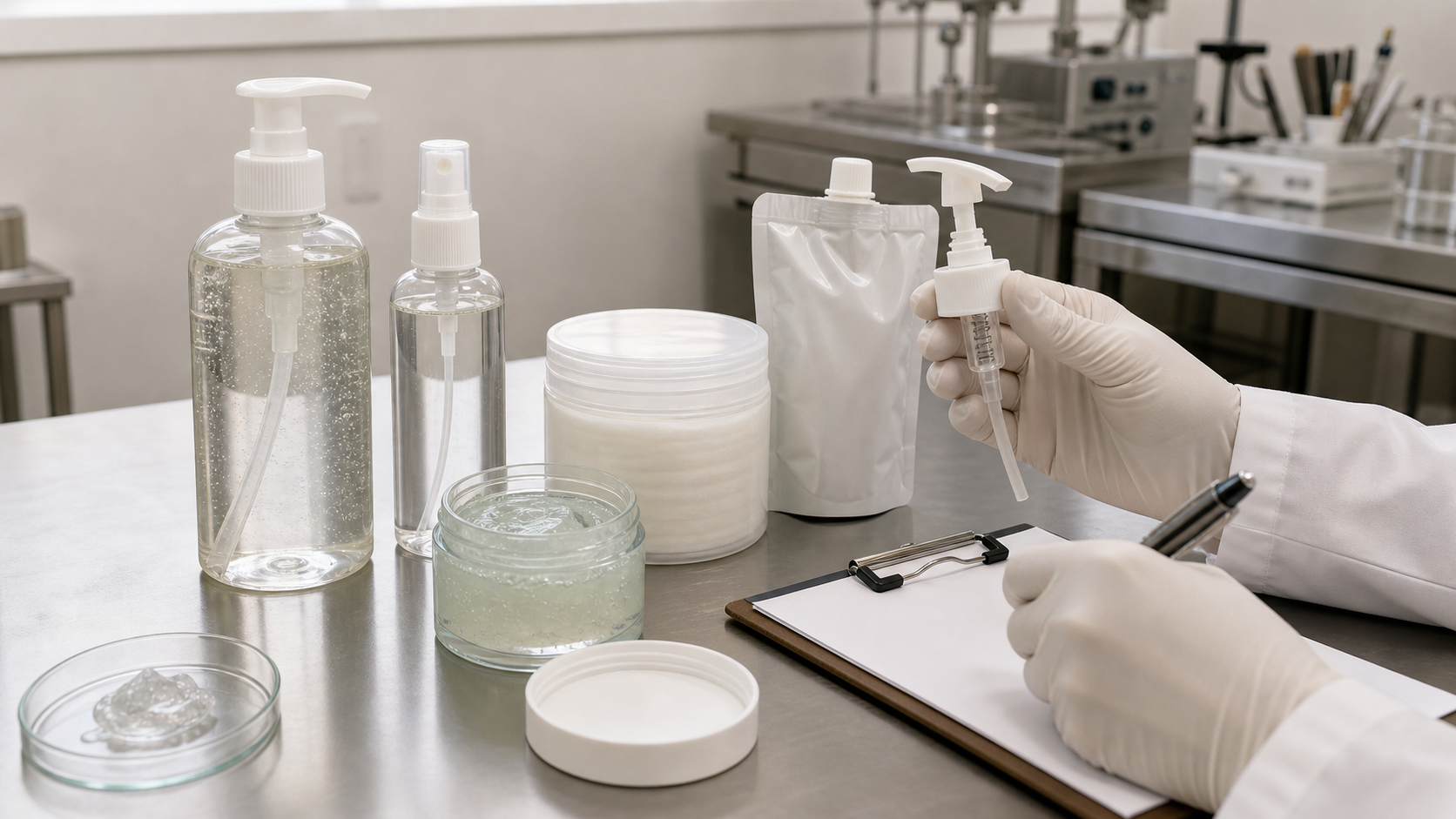
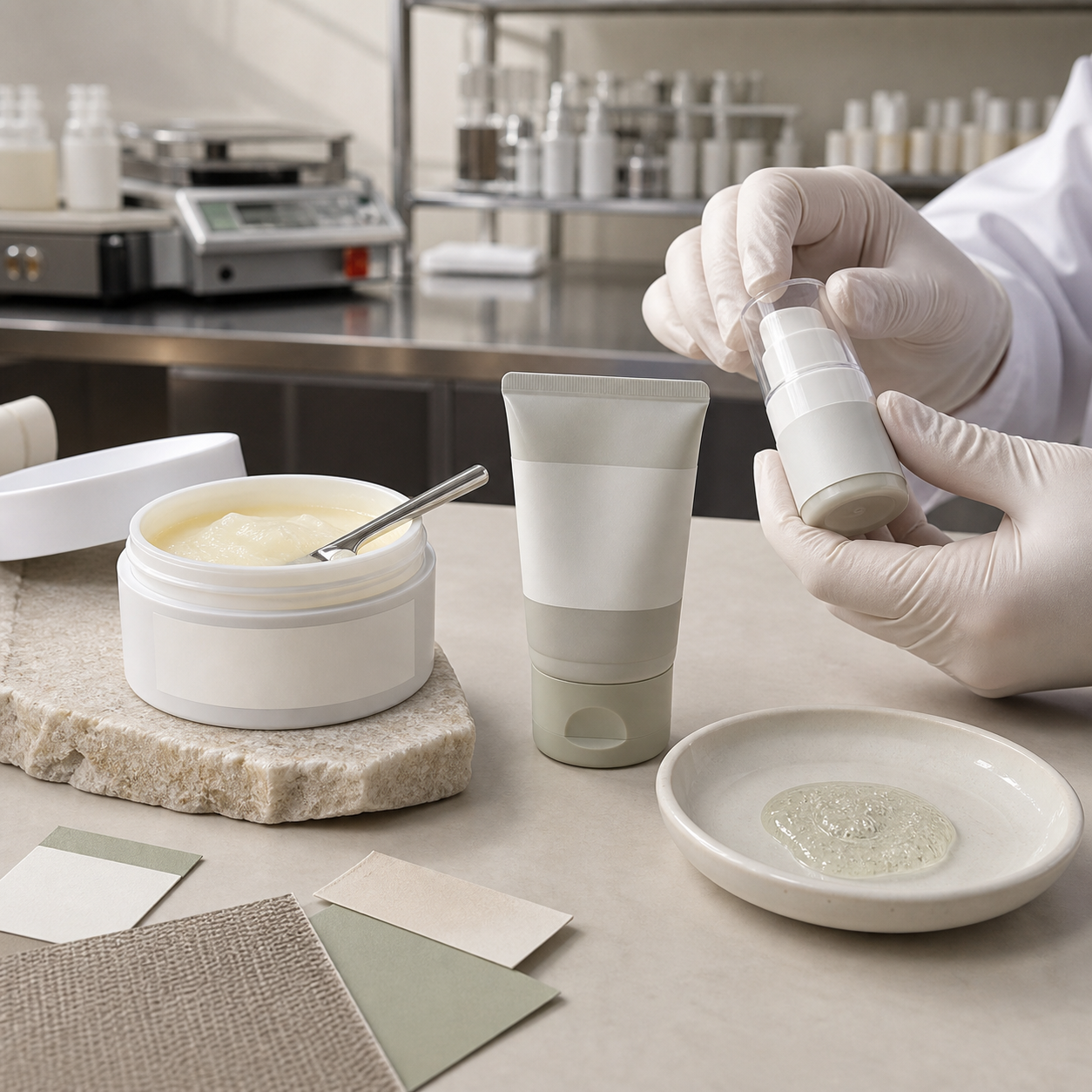
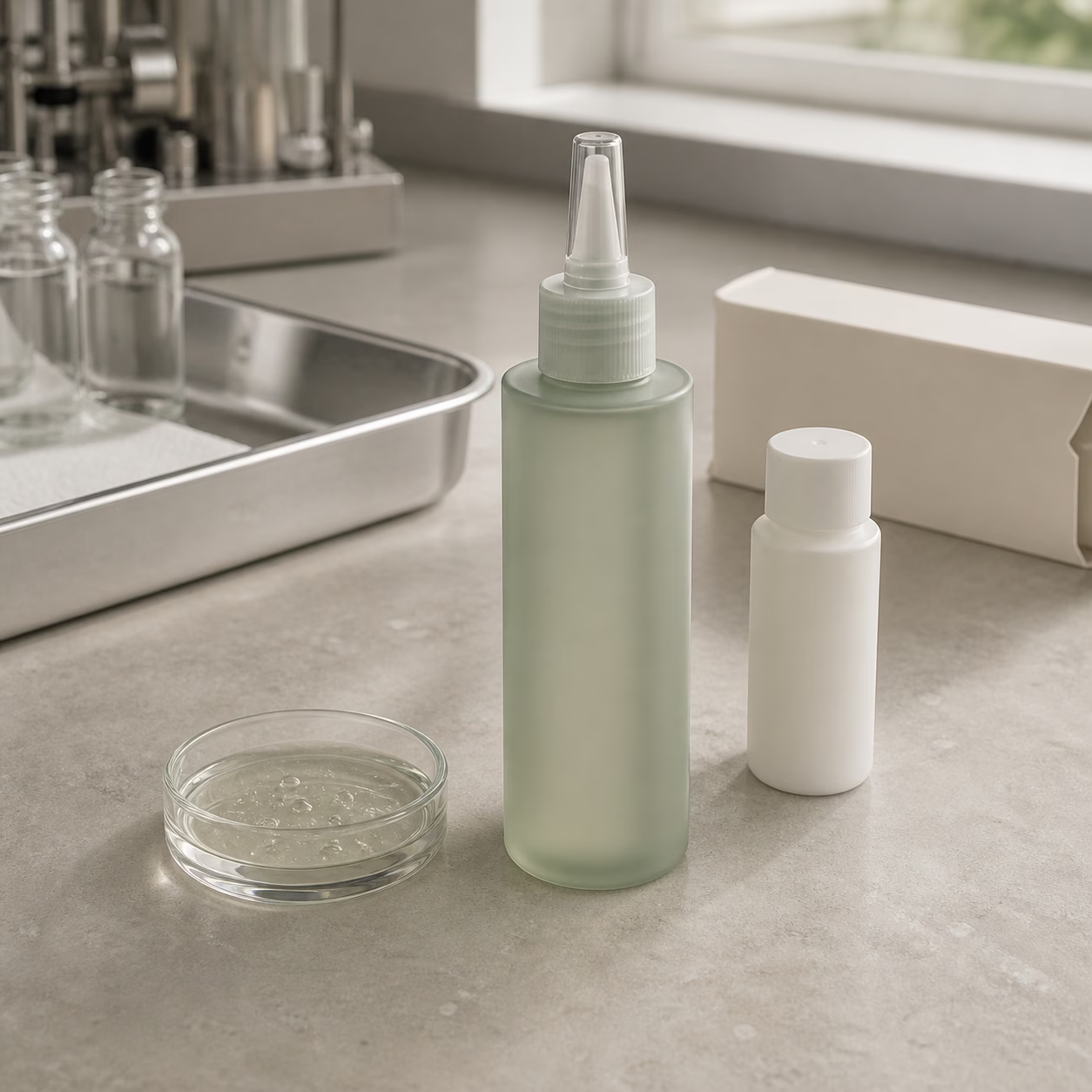
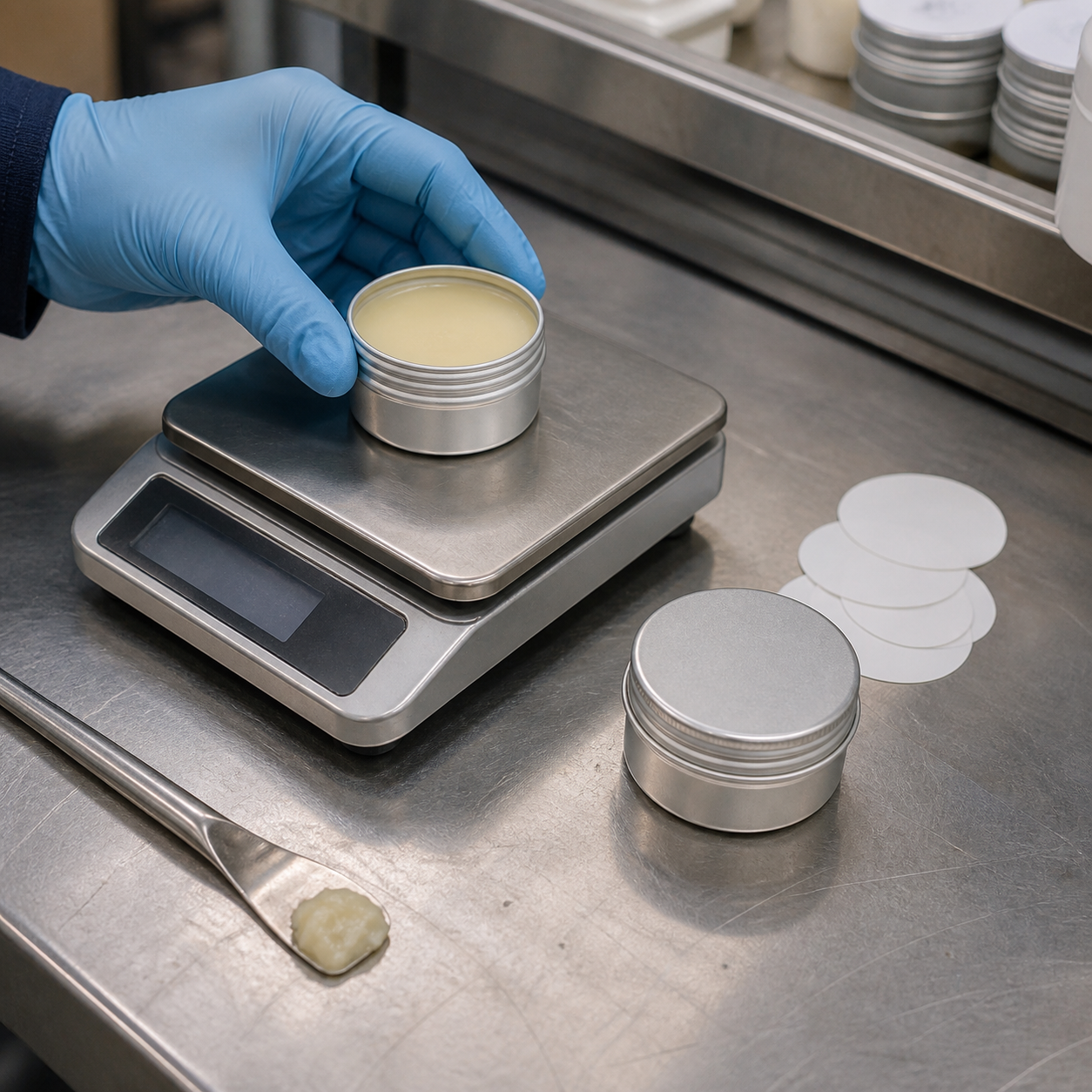
General GUOCUI-owned serum sample and QC workflow image. It does not prove a final formula, active level, test result, or current production batch.
Direct answer: a useful retinoid serum OEM brief does not begin with the biggest percentage on a trend page. It begins with the exact ingredient identity, the supplier raw-material composition, the active-content basis behind any number, the destination market, the intended claims, and the package and stability plan. Without those records, two products that both say “retinoid” or show the same headline percentage may be technically and commercially different.
Recent launch monitoring in late July 2026 reinforced this buyer problem: a headline number may describe the input level of a multi-component supplier blend rather than the percentage of one pure retinoid. That distinction should be resolved inside the RFQ and sample specification, not left for label artwork. GUOCUI BIO TECH / Guangzhou Guocui Biological Technology Co., Ltd. treats the number as the end of a documentation chain, not the start of a marketing promise.
Why “What Percentage Is It?” Is Not a Complete OEM Question
A percentage can refer to pure active, a diluted solution, a carrier blend, an encapsulated material, or the total addition rate of a supplier product. The factory needs the commercial raw-material name, complete INCI, active assay or standardization basis, carrier system, recommended conditions, and supporting TDS, SDS, CoA, stability, handling, and market-use documents. A buyer-facing percentage should never be inferred from the raw-material name alone.
Buyer wording
Factory clarification
Decision it affects
“7% retinoid”
Seven percent of what exact supplied material, with what active assay and carrier?
Formula calculation, artwork, claims, and cost comparison.
“Gentle retinol alternative”
What is the exact INCI and what evidence supports the comparison in the target market?
Claim language, safety review, and buyer education.
“Night serum”
What texture, use amount, routine position, packaging, and warning copy are intended?
Sample brief, package format, instructions, and label area.
“Suitable worldwide”
Which countries and channels are actually in scope?
Ingredient review, notification, artwork, language, and launch timing.
1. Lock the Ingredient Identity and Active-Content Basis
Before sampling, record the exact INCI route being considered. Retinol, retinal, retinyl esters, hydroxypinacolone retinoate, and supplier blends should not be collapsed into one interchangeable ingredient label. Ask the supplier or formulator to identify the material, carrier, assay, recommended use range, storage conditions, light or oxygen sensitivity, incompatibilities, and documentation version.
Create one calculation sheet that separates raw-material addition rate from active-equivalent or assayed content. Keep that sheet internal until the final formula, evidence and destination-market review support a public number. This prevents a supplier blend percentage from becoming an exaggerated product claim.
2. Define the Destination Market Before Formula and Artwork
Regulatory scope changes the project. For example, Commission Regulation (EU) 2024/996 sets Retinol Equivalent limits and a required warning for products containing Retinol, Retinyl Acetate or Retinyl Palmitate. The regulation identifies 0.05% RE for body lotion and 0.3% RE for other leave-on and rinse-off products, with transition dates for non-compliant products. The underlying SCCS opinion explains the consumer-exposure reasoning.
Those provisions name specific vitamin A substances. They should not be casually copied onto a different retinoid identity, and a different identity should not be assumed exempt or approved. Confirm the exact ingredient and seek destination-market regulatory review. A buyer should send target countries, channels, age positioning, planned claims, label languages and any restricted-ingredient policy before the sample formula is locked.
3. Choose Packaging for the Actual Formula
“Use an amber dropper” is not a complete packaging decision. Review the formula against the bottle or airless system, closure, gasket, wiper, dip tube, headspace, fill method, decoration and secondary carton. Light control, oxygen exposure, repeated opening, dose repeatability, component contact and e-commerce handling all matter.
Compare opaque, amber, coated or airless directions only after the formula route is known.
Check whether the closure and decoration remain acceptable after storage and handling.
Record fill appearance, odor, color and dispensing against an approved reference.
Retest when the formula, bottle, pump, closure, supplier, decoration or fill process changes.
4. Build a Stability and Compatibility Matrix, Not One Shelf Photo
A first sample can look attractive and still be a weak production reference. The project team should define appropriate stability, package compatibility and microbiological work for the actual formula and market plan. Record controlled checkpoints for appearance, odor, color, separation, viscosity or flow, pH where relevant, package interaction, leakage, dispensing, closure fit and label condition.
Do not promise a universal timeline before the formula and package route are reviewed. Sample and production timing depends on raw-material availability, sample revisions, packaging samples, testing plan, artwork readiness and destination requirements. MOQ and quotation can be confirmed after formula, packaging, quantity, label requirements and order-plan review.
5. Separate Cosmetic Positioning from Medical or Guaranteed Claims
A private label night serum can be positioned around texture, routine fit, mature-skin care, smoother-looking or refined-looking skin, and a buyer-defined cosmetic story when the formula and evidence support the wording. Avoid acne-treatment, prescription-comparison, pregnancy-safe, peeling-guarantee, wrinkle-removal or clinical-result claims without the required substantiation and specialist review.
Usage copy also needs a real owner. Decide who prepares directions, precautions, patch-test language, routine order and market-specific warnings, and who approves the final version. The factory, buyer and regulatory reviewer should not assume another party has completed this step.
Buyer Handoff Checklist Before Retinoid Serum Sampling
Target countries, sales channels, buyer type and planned launch window.
Exact retinoid or vitamin A direction, ingredient restrictions and supplier-document expectations.
Desired texture, finish, fragrance position, routine role and compatible support ingredients.
Packaging preference, capacity direction, light and oxygen strategy, decoration and carton needs.
Estimated quantity, sample deadline, artwork status, label languages and claim boundary.
Testing, notification, documentation and shipping requirements for the intended market.
Frequently Asked Questions
Does a higher retinoid percentage automatically mean a stronger serum?
No. The number may describe a pure active, a diluted material or the addition rate of a multi-component supplier blend. Compare exact identity, assay, carrier, formula level and evidence before comparing percentages.
Can a buyer choose between retinol, retinal and HPR in one brief?
They can be discussed as separate development routes, but they should not be treated as interchangeable. Each route needs its own supplier documents, formulation plan, stability work, packaging review and market assessment.
Is amber glass always the best package?
No. Amber glass may help one project, while an opaque or airless system may suit another. The final package should be tested with the actual formula, closure, fill process and shipping plan.
Can GUOCUI confirm MOQ and lead time before the formula is selected?
Only a provisional discussion is possible. MOQ, quotation, sample timing and production timing depend on formula, components, decoration, quantity, testing, artwork and order-plan review.
What should be approved before bulk production?
Approve the formula and reference sample, raw-material identity records, package and compatibility results, artwork, instructions and warnings, QC checkpoints, coding areas, carton plan, documents and shipping requirements.
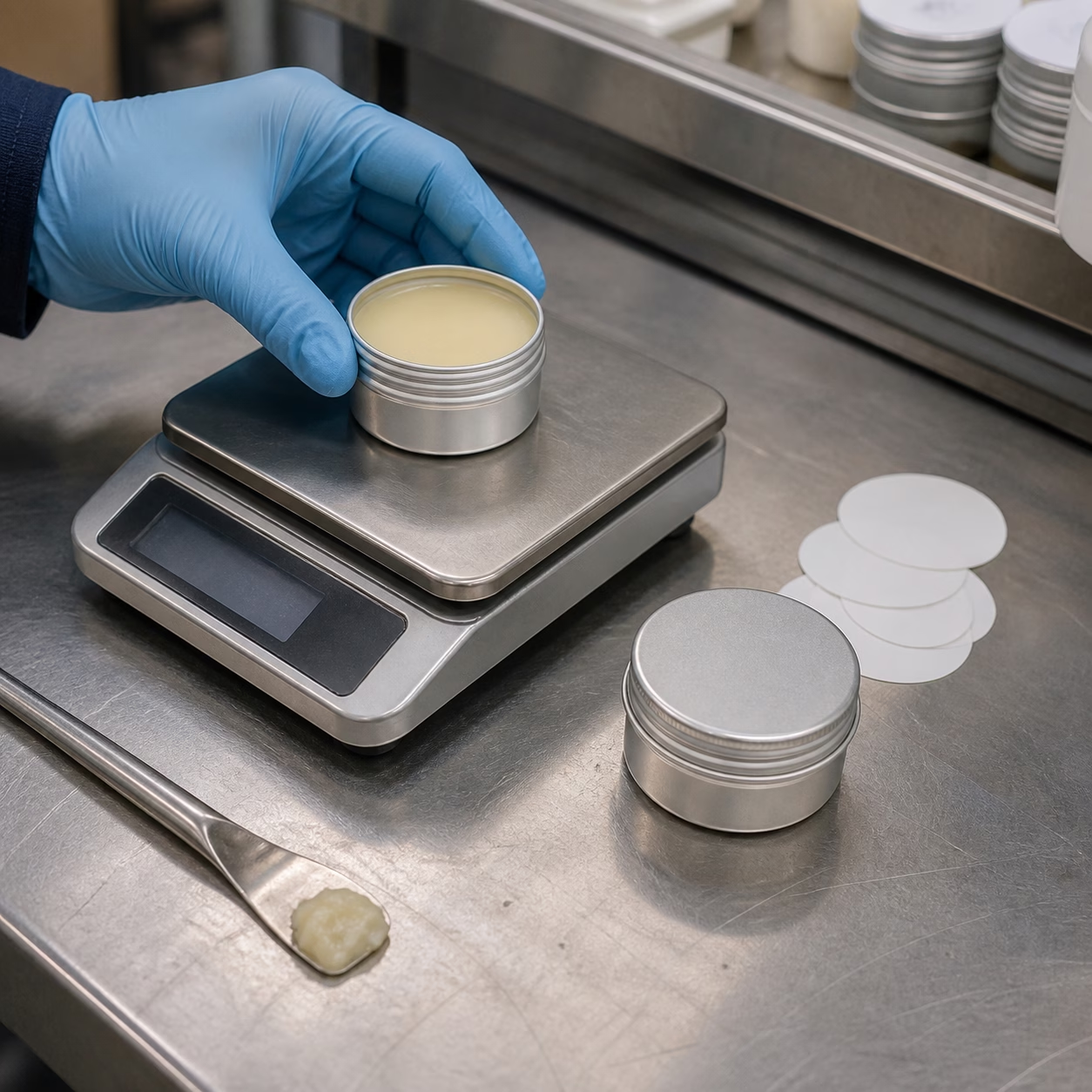
General GUOCUI-owned sample and QC workflow image. It does not show the final buyer package, a current production batch, or certified shipment proof.
E-Commerce Skincare Packaging Must Be Proven as a Filled System
Direct answer: a closure described as e-commerce-ready is a useful starting point, but it is not approval for a private label skincare SKU. The factory and buyer still need to test the actual formula, bottle, neck finish, closure, liner or seal, label, secondary pack, shipping carton, and fulfillment route as one filled packaged-product. A different viscosity, bottle wall, torque setting, headspace, decoration, or carton can change leakage and damage performance.
This distinction matters for online beauty sellers because the package is handled many times before the buyer opens it. It may be stored on its side, exposed to temperature changes, dropped inside an over-box, compressed beside other items, or opened after pressure has built around the closure. GUOCUI BIO TECH / Guangzhou Guocui Biological Technology Co., Ltd. uses supplier information as an engineering input, then brings the real filled sample back into formula-package review, packing checks, and buyer approval.
What a Closure Claim Does and Does Not Prove
A July 2026 supplier announcement introduced several closures positioned for e-commerce and reported Amazon ISTA-6 robustness testing at portfolio level. That is relevant market evidence, but it does not prove a GUOCUI buyer’s final combination. ISTA guidance is explicit that test procedures apply to a specific packaged-product system, not an individual packaging material in isolation. It also recommends retesting when the product, package, or process changes.
Evidence available
What it can support
What remains open
Closure supplier specification or prior test
Shortlisting, component questions, sample request, and preliminary risk review
Performance with the selected formula, bottle, torque, seal, decoration, carton, and route
Empty package fit check
Thread engagement, cap alignment, label area, appearance, and basic operation
Formula compatibility, dispensing, closure cleanliness, and early handling checks
Production consistency, packed-product transport performance, and approved change control
Route-appropriate packaged-product test
Evidence for the tested SKU, pack configuration, and documented conditions
Any later material, component, formula, fill, carton, or process change
Six Checks Before Approving E-Commerce Skincare Packaging
1. Freeze the exact formula and fill condition
Record viscosity, density, oil and surfactant direction, pH where relevant, fill temperature, target fill weight, headspace, and any settling or phase behavior. A water-thin toner, gel cleanser, body wash, cream, and oil do not load the same closure in the same way. Use production-representative samples rather than water-filled demonstration bottles.
2. Match the bottle neck and closure specification
Confirm the neck finish, thread, sealing land, dip tube or orifice, liner or plug, cap material, bottle material, and supplier drawing revision. Ask which torque range and assembly method the closure expects. A visually compatible cap is not enough if the thread, sealing surface, or application torque differs.
3. Test dispensing and residue after real use
Check first opening, priming, dose, flow, cutoff, stringing, clogging, cap contamination, and one-handed use. Repeat after the sample has rested in different orientations. The goal is not only to prevent obvious leakage; it is also to confirm that the package remains clean and understandable after repeated consumer use.
4. Challenge the filled primary pack
Use a documented plan for upright, side, and inverted storage; temperature exposure; pressure or vacuum where relevant; vibration; impact; and post-test opening. Inspect the seal area, thread, label, pump or cap, bottle panels, and product appearance. The exact method should match the product risk, target market, fulfillment route, and any retailer or carrier requirement.
5. Test the retail unit inside its shipping configuration
Add the real carton, insert, protective material, over-box, orientation, unit count, and shipping weight. Inspect scuffing, cap impact, accidental opening, label damage, carton collapse, and product movement. Testing a closure by itself cannot reveal whether another item in the parcel presses directly on the cap.
6. Create a retest trigger list
Retest or formally review changes to the formula, fragrance, colorant, fill weight, headspace, bottle resin, neck finish, closure resin, liner, supplier, torque, label, carton, insert, unit count, packing method, or fulfillment route. The approved sample and test report should identify the exact revision tested so a later substitution is visible.
Buyer Handoff Checklist for OEM Quotation and Sampling
Buyer handoff checklist: send enough information for the factory to price the right package and plan the right sample, not just a bottle screenshot.
Product format, texture or viscosity direction, target fill size, and fragrance or color requirements.
Target country, Amazon or other sales channel, fulfillment route, parcel configuration, and any retailer test requirement.
Known leakage complaints, acceptable test scope, sample deadline, launch timing, and who approves package changes.
MOQ and quotation depend on formula, components, decoration, quantity, label requirements, testing, packing, and shipping plan. Sample and production timing can be confirmed after component availability, formula-package fit, artwork readiness, test scope, and revision ownership are reviewed. GUOCUI does not use one fixed number or lead-time promise for every custom e-commerce project.
Factory and QC Records Buyers Should Expect
A practical handoff can include the approved formula and filled sample reference, component supplier and drawing revision, incoming package checks, application settings, fill and assembly record, leakage or compatibility observations, artwork version, packed-unit configuration, deviation notes, and release owner. The exact record set depends on the project, but every important claim should point back to the tested configuration.
The useful conclusion for overseas buyers is short: supplier evidence helps choose a component; packaged-product evidence approves a SKU. Keep those two layers separate, and re-open the test decision whenever a material change appears.
Frequently Asked Questions
Does an e-commerce-ready closure guarantee no leakage?
No. It indicates a design direction or prior evidence boundary. The buyer’s filled formula, bottle, closure, assembly settings, secondary pack, shipping configuration, and route still need project-specific review and testing.
Can GUOCUI use a buyer-selected pump or cap?
GUOCUI can review a buyer-selected component, but feasibility depends on the exact formula, bottle neck, supplier specification, sample availability, decoration, filling process, test plan, quantity, and destination requirements.
When should a private label skincare package be retested?
Retest or formally reassess when the product, package, process, or distribution route changes in a way that may affect performance. Track formula, component, material, supplier, torque, fill, carton, insert, packing, and route revisions.
What should an Amazon beauty seller send before quotation?
Send the product format, target size, formula direction, package concept, fulfillment route, individual and shipping-pack configuration, estimated quantity, artwork status, test requirement, and launch window.
Direct answer: a private label skincare gift set should not move to quotation as a loose list of products. The buyer and factory first need one set architecture that connects the formulas, primary containers, individual cartons, insert, outer box, label hierarchy, assembly method, and shipping carton. If one layer changes after sampling, the other layers may need to be checked again.
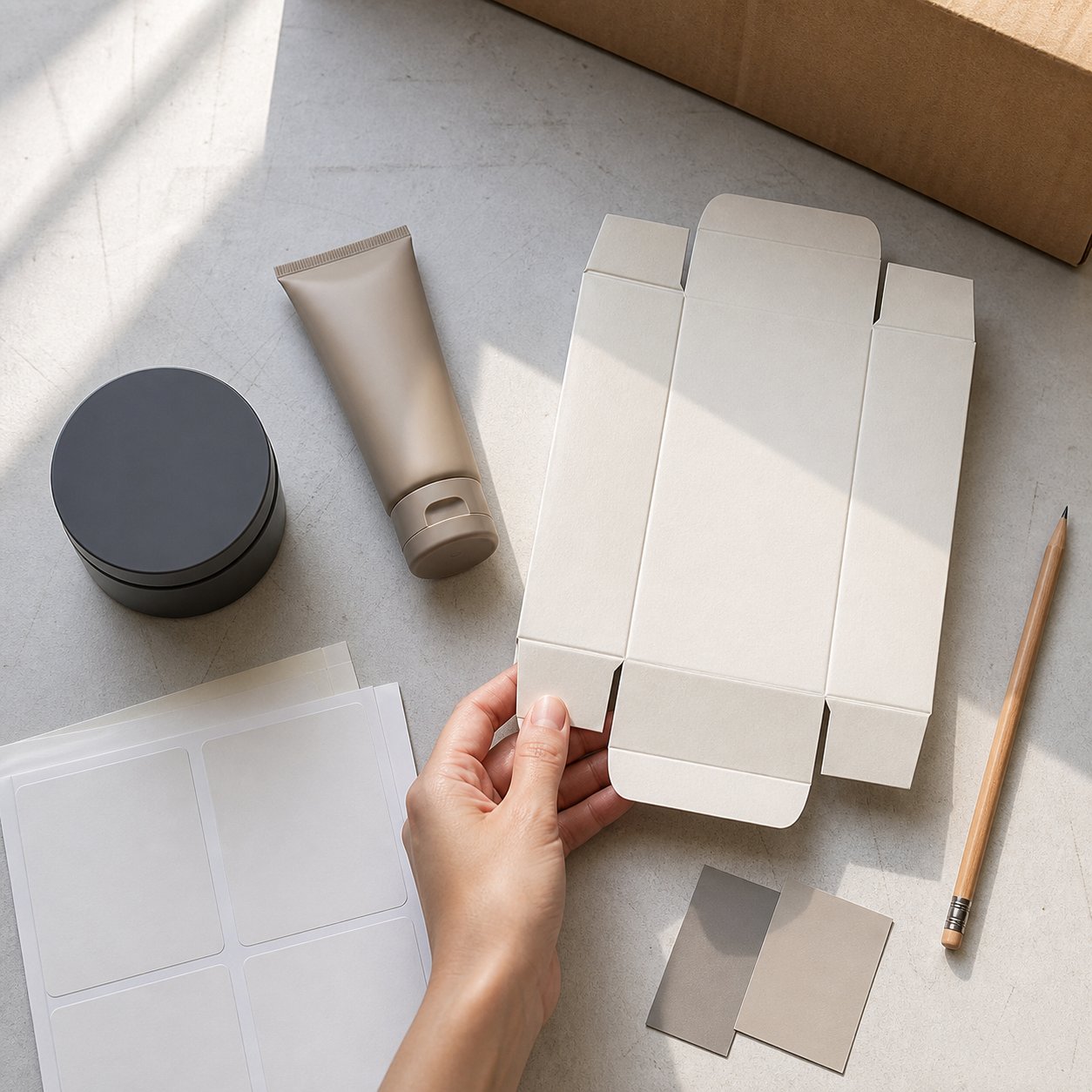
This is a GUOCUI-owned general gift-set packaging workflow visual. It shows blank sample components and is not evidence of a final buyer formula, artwork, or production batch.
For overseas brand buyers, the practical question is not simply “Can you make a gift box?” It is “Which product and packaging decisions must be fixed before the factory can build a sample that represents the intended launch?” GUOCUI BIO TECH uses that question to keep a seasonal or channel-specific set from becoming a chain of late artwork, fit, and quotation changes.
What “set architecture” means in an OEM project
Set architecture is the relationship between every item inside the kit and the packaging around it. A serum bottle, cream jar, mist bottle, and mask sachet may each be feasible on their own, but the combination still needs a shared size plan, pack hierarchy, artwork system, and assembly sequence.
Layer
Buyer decision
Factory review
Product mix
Two to four formats, target channel, use order
Formula route, compatibility, sampling scope
Primary pack
Bottle, jar, pump, dropper, sachet, capacity direction
Closure fit, leakage risk, fill and label area
Unit carton
Which items need individual boxes
Dieline, copy space, local language, component protection
Insert
Paperboard or molded insert, display order
Clearance, grip, removal, movement during transport
This structure also helps with SEO-style product language because it keeps the public description tied to real buying decisions: custom formula direction, custom skincare gift box, private label artwork, sample assembly, QC review, and export preparation.
Choose the product route before designing the box
There are two common starting routes. A ready-formula set can shorten early development because the buyer is selecting from reviewed formula directions and focusing more heavily on packaging, labels, and channel presentation. A custom-formula set gives the buyer more control over texture, fragrance, ingredient direction, and product positioning, but it creates more sample and compatibility decisions.
Neither route has a universal MOQ, price, or timeline. Quotation depends on the chosen formulas, container availability, decoration method, carton structure, number of SKUs, assembly work, quantity, label requirements, and shipping plan. A three-item kit can be simpler than a four-item kit, but only if the packaging and formula choices are also simpler.
Build from product to transport, not from artwork alone
A visually attractive box is not yet a manufacturable set. The sequence should normally move from product direction to primary packaging, then to unit cartons, insert, outer box, and shipping protection. That order gives the designer real dimensions instead of estimated rectangles.
Confirm the set brief. State the target market, buyer type, sales channel, product mix, launch window, and expected quantity range.
Choose formula and pack directions. Match each texture to a practical bottle, jar, pump, tube, pouch, or sachet route.
Collect component dimensions. Use supplier-confirmed measurements before final insert and carton artwork.
Review the label hierarchy. Decide what belongs on the primary pack, individual carton, set box, and shipping carton.
Make an assembled sample. Check how products sit, how buyers remove them, and whether labels remain visible.
Confirm the packing sequence. Define item order, insert placement, inspection points, sealing, and case packing.
Artwork handoff needs a file map
A multi-item gift set can contain several dielines and repeated claims. The buyer should send an artwork map that identifies the latest file for each bottle label, unit carton, insert card, sleeve, outer box, and master-carton mark. File names should include the SKU or component and version date. The factory should not have to guess whether “final-v2” or “final-new” is the approved file.
Market wording also needs its own review. The FDA explains that cosmetics sold in the United States must follow applicable cosmetic labeling rules and that required information may apply to labels and accompanying packaging. EU packaging requirements also create packaging-design and waste-prevention considerations. These sources are planning references, not a substitute for the buyer’s destination-market compliance review. Keep claims truthful, cosmetic, and consistent across every layer.
Sample the assembled system, not only each formula
Formula samples answer questions about texture, scent, color, spread, and skin feel. Packaging samples answer questions about bottle, closure, print, label, and carton. A gift-set sample must connect both. The assembled sample should be checked for insert clearance, product movement, label orientation, opening effort, rubbing, carton pressure, and obvious presentation gaps.
GUOCUI buyers can also request a packing discussion before bulk production. A practical review may cover the approved component list, assembly order, label position, carton count, outer-box protection, and the records needed for shipment preparation. It should not be presented as proof of a buyer’s final production order until the specifications are approved.
Buyer handoff checklist
Target country or region and sales channel.
Set concept, buyer audience, and expected launch window.
Two to four preferred product formats and formula route.
Container type and approximate capacity for each item.
Need for individual cartons, insert, sleeve, ribbon, or information card.
Logo files, artwork status, language plan, and responsible reviewer.
Estimated quantity range and whether one sample set or several variants are needed.
Shipping destination and any buyer-specific carton-mark requirements.
Can GUOCUI combine different skincare formats in one private label gift set?
Yes. Buyers can discuss combinations such as serum, cream, mist, mask, cleanser, body care, or lip care. The final mix depends on formula review, package fit, channel positioning, and the set assembly plan.
Does a skincare gift set have one MOQ?
Not automatically. The practical MOQ can be influenced by each formula, primary container, decoration process, printed carton, insert, outer box, and assembly requirement. GUOCUI confirms the quotation logic after the full set brief is reviewed.
Should the box artwork be finished before sampling?
The brand direction can start early, but final dielines should use confirmed component dimensions. Buyers should avoid approving detailed insert and outer-box artwork from estimated bottle or jar sizes.
Can one assembled sample represent bulk production?
It can confirm the intended direction, fit, and presentation, but production still depends on approved specifications, available components, artwork files, QC points, and the final order plan.
What should a buyer send first?
Send the target market, sales channel, preferred product mix, package direction, quantity range, artwork status, and launch timing. GUOCUI can then identify the next formula, packaging, sample, and quotation questions.
Short conclusion: a skincare gift set becomes quotation-ready when every product and packaging layer belongs to one reviewed system. Lock the architecture first; then sample, check, and price the complete set.
Direct answer: An antioxidant serum OEM brief is not ready when it contains only an ingredient wish list. Before sampling, the buyer and factory should agree on the target user, cosmetic claim boundary, color and odor acceptance, primary pack, dispensing system, label market, sample checkpoints and quotation variables. Those decisions turn a trend direction into a testable private-label project without copying another brand’s formula story or package identity.
Recent antioxidant-serum activity is a useful sourcing signal, but GUOCUI BIO TECH treats it as a reason to improve the handoff process rather than reproduce a branded product. Guangzhou Guocui Biological Technology Co., Ltd. can discuss a custom formula, standard or custom packaging, label localization and sample review for overseas brands, distributors, salons, spas and online beauty sellers. Final ingredient levels, claims, pack materials, MOQ, quotation and timing are confirmed after the project brief is reviewed.
A neutral GUOCUI sample-review scene: formula appearance, bottle choice, closure fit, label stock and carton preparation are checked together before a buyer approves a direction.
What is an antioxidant serum OEM stability handoff?
It is a short decision record connecting the buyer’s market idea to the factory’s sample and packaging work. It does not promise shelf life or performance before testing. Instead, it states what the sample should look and feel like, which variables must be monitored, how the pack will be used, and what evidence the buyer needs before approving the next round.
This matters because a serum can change when the formula, headspace, bottle color, closure, dispensing parts, filling process or storage exposure changes. A pack that looks premium in a rendering may dispense poorly, leak during transport or make visual change harder to assess. GUOCUI therefore recommends evaluating formula and package as one project rather than approving them in separate conversations.
Choose the channel before choosing the serum story
A clinic-adjacent line, a salon retail shelf, an Amazon listing and a social-commerce launch do not need the same brief. A professional channel may prioritize controlled dispensing and restrained artwork. A marketplace seller may need a compact shipper, durable closure and clear variation control. A distributor may need multilingual label space and a packaging family that can expand to toner, cream or mask later.
Tell the factory the intended countries, sales channel, target retail position, planned bottle size, expected routine position and whether the launch is one hero SKU or part of a set. This helps the team propose realistic bottle, carton, label and sample options without inventing a fixed MOQ or lead time too early.
Eight checkpoints to put into the first sample brief
Checkpoint
Buyer decision
Factory review
Formula direction
Water-light, cushiony or richer serum; fragrance preference; target routine step
Feasible ingredient system, texture route and cosmetic claim wording
Appearance baseline
Acceptable initial color, clarity and natural odor range
Record sample observations and flag visible drift for review
Skin-feel target
Slip, absorption, residue and layering expectation
Compare agreed sensory checkpoints rather than retail slogans
Primary packaging
Dropper, treatment pump or airless direction; bottle size and finish
Check component compatibility, closure fit and dispensing behavior
Artwork space
Front-panel hierarchy, languages, responsible-party and market fields
Review dieline, label stock, print area and carton fit
Sample acceptance
Who approves formula, pack and artwork, and by what date
Keep each approved version traceable before production planning
Transport scenario
Parcel, wholesale carton, hot route or long transit concern
Discuss protective packing and project-specific test needs
Quotation inputs
Quantity range, pack option, decoration, market and shipping plan
Quote only after variables are sufficiently defined
Keep the public claim narrower than the development ambition
For a cosmetic private-label project, safer early language includes antioxidant formula direction, radiance-looking care, smoother-looking texture, moisturizing feel and daily serum positioning. Avoid turning a trend signal into an unverified medical, treatment, reversal, clinical or guaranteed-performance claim. The label and marketing copy should be reviewed for the destination market before printing.
The same rule applies to ingredient storytelling. A buyer may ask about vitamin C derivatives, tocopherol, ferulic-acid positioning, botanical antioxidants, peptides or barrier-support ingredients. The factory can discuss compatible directions, but the final combination and level should follow formula feasibility, stability work, raw-material documentation, claim support and market requirements. A competitor’s exact ratio, proprietary complex, patent story or recognizable product name is not a valid shortcut.
Package-fit questions that prevent late rework
Ask whether the buyer wants a dropper ritual or controlled-dose pump, whether the bottle must fit a standard shipper, and whether the label needs several languages. Confirm whether the chosen decoration will tolerate handling and whether the carton leaves enough room for required copy. For every shortlisted component, review fill volume, closure engagement, dispensing consistency, leakage risk, label adhesion and visible appearance after handling.
Pharmaceutical packaging standards are not a substitute for cosmetic product testing, but they reinforce a useful general principle: the container-closure system and its materials can affect product quality. The practical OEM action is to define a cosmetic-appropriate compatibility and observation plan for the actual formula and actual pack instead of assuming that a supplier catalog image proves fitness.
How GUOCUI moves from request to an approvable sample
Brief review: the export team checks channel, market, formula direction, pack, artwork and missing quotation inputs.
Option alignment: the team narrows texture, ingredient and packaging directions that fit the project.
Sample preparation: formula and pack samples are identified so feedback is tied to the correct version.
QC and pack-fit discussion: appearance, sensory targets, dispensing, closure and artwork placement are reviewed.
Buyer confirmation: requested changes are recorded before quotation and production planning move forward.
Label and packing handoff: final market copy, decoration files, carton structure and shipment preparation are coordinated.
MOQ and quotation depend on formula, packaging, quantity, decoration, label requirements and shipping plan. Sample and production timing can be confirmed after formula and packaging review. This variable-based approach is more useful than a generic low-MOQ promise because it shows the buyer which choices actually change cost and timing.
Buyer handoff checklist
Target countries and buyer channel
Desired serum texture, finish and routine position
Preferred ingredient directions and excluded ingredients
Cosmetic benefit wording the buyer wants to explore
Bottle type, size, color, pump or dropper preference
Logo, label languages, carton and set requirements
Estimated quantity range and target launch window
Sample quantity, review owner and acceptance method
Can GUOCUI copy a branded antioxidant serum formula?
No. A market example may identify a category need, but the public product, formula brief, packaging, artwork, name and claims should be developed as an original GUOCUI OEM/ODM direction.
Which package is best for an antioxidant serum?
There is no universal answer. The choice depends on the formula, dispensing target, fill size, decoration, market, user experience and compatibility review. Dropper, treatment-pump and airless directions can be discussed during sampling.
Can GUOCUI confirm MOQ and price before the package is selected?
A preliminary discussion is possible, but a useful quotation needs the formula direction, quantity range, primary pack, decoration, carton, label and shipping requirements.
What should the buyer approve in a serum sample?
Approve the identified formula version, appearance range, odor, texture, absorption, residue, dispensing behavior, pack fit and any artwork mockup. Record change requests against that exact version.
Does a sample review prove shelf life?
No. A sample review is an early decision gate. Shelf-life and market claims require the appropriate project-specific testing, documentation and market review.
Direct answer: A private label cream design-around starts by separating the useful product idea from another brand’s identity. Keep the buyer problem, texture target, application experience and channel need. Rebuild the formula brief, packaging structure, color system, artwork, claims and sample tests for the buyer’s own market. GUOCUI BIO TECH can then review the concept as a custom formula, private label or OEM/ODM project without carrying competitor names, campaign language or distinctive packaging into the brief.
Neutral cream packaging options for formula, dispensing, artwork and pack-fit discussion. The image is a GUOCUI-owned sample-workflow visual, not a finished buyer brand.
What design-around means in skincare OEM work
Trend research can reveal a real buyer question: perhaps customers want a rich cream that leaves a high-gloss finish, a compact pump for hygienic application, or a stronger nighttime-care story. Those are useful development signals. The risk begins when the brief also preserves the source product’s name, proprietary ingredient story, exact color combination, label hierarchy, container silhouette and campaign composition.
Product packaging can contribute to the overall commercial impression of a product. For that reason, a practical OEM brief should not treat a logo swap as sufficient differentiation. This article is an operational checklist for product development and is not legal advice; buyers should arrange market-specific trademark, design and claim review with qualified advisers.
Separate the transferable idea from the source identity
Research observation
Do not carry forward
New buyer decision
A glossy, cushioned cream finish attracts attention.
A proprietary series name, exclusive ingredient name or copied claim.
Define spread, absorption, after-feel and makeup compatibility in sample terms.
A distinctive jar or pump supports the story.
The same unusual shape, color blocking, graphics and label hierarchy.
Select a compatible standard package, then build an original color and artwork system.
A strong problem-and-solution narrative is memorable.
Campaign slogans, character concepts, dramatic treatment language or before-and-after framing.
Use a cosmetic buyer problem such as dry-feel comfort, barrier-care positioning or makeup-ready finish.
A premium routine can justify several touchpoints.
A copied set architecture or identical launch bundle.
Choose a channel-specific single product, duo or routine based on the buyer’s assortment.
Nine decisions before a custom cream sample
1. Define the buyer and sales channel
An Amazon seller, salon range, distributor and TikTok-focused brand do not need the same cream brief. Tell the factory the target country, channel, expected retail position, buyer age group and whether the product belongs in a simple routine or a larger collection. These inputs affect pack size, claim language, carton information and the amount of education needed on the page.
2. Describe texture with observable sample language
Replace vague requests such as “luxury texture” with decisions a sample team can evaluate: gel-cream or buttery cream, quick break or long cushion, low tack or protective after-feel, soft matte or visible glow, fragrance-free or restrained fragrance. If makeup compatibility matters, specify pilling, spread and waiting-time checks rather than promising a perfect result before sampling.
3. Build a non-proprietary formula direction
Use familiar cosmetic categories such as humectants, emollients, ceramide-positioned barrier care, panthenol, beta-glucan, peptides or antioxidant directions when they suit the project. Final ingredients, percentages and claims must follow formula feasibility, stability, target-market and evidence review. A source product’s proprietary complex or patented story should remain outside the public brief unless the buyer has the right and documentation to use it.
4. Set a conservative claim boundary
Early copy can focus on moisturized feel, smoother-looking finish, comfort-feel care and support for a well-conditioned appearance. Avoid clinical, treatment, regeneration, guaranteed duration or age-reversal language unless the finished formula and destination-market evidence support it. Claims should be reviewed again when the final INCI, test plan and label are available.
5. Choose packaging for the formula, not the reference photo
Jar, airless pump and tube options should be compared against viscosity, dose, fill volume, oxygen exposure, decoration area and user handling. Ask the sample team to check pump output, closure fit, leakage, label adhesion and carton fit. A visually interesting package that cannot dispense the selected texture is not a useful design-around.
6. Rebuild the visual system
Create an original palette, material mix, logo scale, label hierarchy, carton layout and photography direction. Change several connected elements rather than one color. Avoid copying a recognizable container silhouette, dominant color combination, graphics, campaign prop or shot composition. Keep generic sample packs blank until the buyer’s artwork is ready for review.
7. Agree on sample acceptance checks
The buyer should review appearance, odor, spread, absorption, tack, after-feel, package output and use with adjacent routine products. Record what passed, what needs adjustment and which pack was used. A clear acceptance sheet prevents the bulk order from depending on memory or a social-media reference image.
8. Prepare label and export information
Share destination country, required languages, responsible-party details, barcode or lot-area needs, carton marks and any document expectations. Ingredient wording, warnings, directions and claims should be checked against the intended market. GUOCUI can coordinate packaging copy and production information, while the buyer remains responsible for the final market route and professional compliance advice.
9. Give the factory enough information to quote
Quotation depends on formula complexity, package, decoration, quantity, label languages, carton structure, set requirements and shipping plan. MOQ, sample timing and production timing can be confirmed after those variables are reviewed. A complete brief produces a more useful quotation than asking for a copied retail product at an unspecified quantity.
Buyer handoff checklist
Target country, sales channel and intended buyer.
Product positioning and cosmetic claim boundary.
Texture, finish, fragrance and ingredient directions.
Jar, pump or tube preference, capacity and decoration method.
Original color, label, carton and product-photo direction.
Estimated quantity, target launch timing and shipping plan.
Sample acceptance tests and final decision owner.
Label languages, market documents and review responsibilities.
Frequently asked questions
Can GUOCUI copy a trending cream exactly?
No. A safer project converts the buyer need into a new formula, sensory, packaging and visual brief. Competitor names, proprietary stories, source images and distinctive packaging should not become the new public product identity.
Can a buyer send reference links?
Yes. Reference links can help explain texture, channel, pack function or user experience. Mark which elements are only research signals, then document the new decisions that will define the buyer’s own project.
When should packaging be selected?
Discuss packaging early, but confirm it with the selected formula. Viscosity, dose, closure, label area, decoration and transport checks can change the final choice.
Does a design-around replace legal review?
No. It is a product-development discipline, not a legal clearance. Buyers should conduct appropriate trademark, design, artwork and market-claim review before launch.
What should a buyer send first?
Send the target market, channel, texture, package, quantity range, launch timing and the elements that must be original. GUOCUI can then organize the next formula, sample, artwork and quotation questions.
AI-generated illustrative sample and spray-test scene for this buyer guide. It is not GUOCUI factory photography and does not count as product-gallery evidence.
Direct answer: a dual-phase facial mist OEM brief should define how the two phases separate and remix, how the pump atomizes the formula, how the mist behaves over bare skin or makeup, and how the filled pack survives storage and shipping. A trend-led concept is not ready for quotation until these measurable decisions are attached to a formula, bottle, actuator, label, carton, quantity plan, and target market.
A late-July retail launch brought shake-to-activate facial mist formats back into the product-development conversation. That is an early format signal, not proof of category growth, sales velocity, or guaranteed buyer demand. For a private label skincare buyer, the useful part is the format: a visible phase boundary, a repeatable shake-and-mist ritual, and a formula-package system that can be tested before production.
This guide turns that signal into a practical brief for GUOCUI BIO TECH. It does not copy a retail brand name, proprietary ingredient system, clinical percentage, emotional-wellness promise, package silhouette, color code, image, or advertising language. The goal is a distinct dual-phase facial mist OEM direction that an overseas B2B buyer can evaluate at the sample table.
Start with the job of the mist
“Hydrating mist” is too broad for development. Tell the factory when the product will be used and what the buyer should notice. A pre-makeup direction may prioritize a fine, even spray and low residue. A midday refresh direction may prioritize fast remixing and a light after-feel. A salon or spa retail direction may allow a more visible phase contrast and a larger pack. A travel SKU needs extra attention to actuator locking, cap retention, leakage, and carton fit.
Keep public cosmetic wording modest until evidence is available. “Fresh-feel,” “light moisture,” “soft after-feel,” and “makeup-compatible direction” describe a development target. They do not promise pore change, psychological effects, treatment, anti-inflammatory action, or a guaranteed result.
Six decisions that belong in the first factory brief
Decision
What the buyer should specify
What the sample review should show
Phase behavior
Visible contrast, acceptable separation time, shake instructions, desired remix appearance
Repeatable separation and remixing with no unexpected sediment, ring, or persistent clump
Spray character
Fine mist, spray width, actuation feel, face distance, target dose direction
Even spray card pattern without jetting, sputter, clogging, or oversized droplets
Skin finish
Bare-skin or over-makeup use, fragrance preference, tack limit, glow or natural finish
Spread, dry-down, residue, comfort, and makeup disturbance under the intended routine
Pack system
Bottle material, capacity, neck finish, pump, cap or lock, decoration
Formula compatibility, priming, dip-tube reach, closure fit, label area, and repeated use
Channel format
Ecommerce, salon, spa, distributor, travel, gift set, or creator-led launch
Pack size, shelf story, carton protection, instruction clarity, and set configuration
A locked scope for quotation rather than an assumed fixed MOQ, price, or timeline
Why formula and spray pump must be reviewed together
A mist package cannot be chosen from bottle appearance alone. Viscosity, oil-phase behavior, suspended materials, fragrance load, pH, and ingredient compatibility can change priming and atomization. The neck finish, actuator, dip tube, gasket, cap, and bottle material also affect performance. A pump that works with a water-like toner may not give the intended pattern with a separated formula.
For that reason, request filled compatibility samples rather than approving an empty component. Review the first actuation, spray after standing, spray immediately after shaking, repeated actuations, and the final portion of the bottle. Put a dark and a light spray card behind the test so the team can see width, density, large droplets, and directional bias. Record the bottle, pump batch, formula version, fill date, and observation date.
An ingredient supplier’s representative biphasic mist formula can help explain phase density, package type, and stability planning, but it is not a finished commercial formula or a promise that another composition will behave identically. GUOCUI should confirm the selected formula and component combination through its own agreed sample and QC plan.
Build a claim-safer custom formula direction
The visible two-phase format already provides a clear product story, so the formula does not need a copied proprietary complex. A buyer can brief a water-rich phase for light moisture and an emollient phase for a soft sensory finish, then choose a distinct mineral-blue, clear, or low-saturation color system that is feasible for the formula and target market. The final ingredient direction depends on stability, preservation, color, odor, compatibility, and local cosmetic requirements.
Avoid naming the product after a competitor, using a lookalike bottle, or reproducing a signature color split. Also remove retail clinical percentages, “mood-boosting” treatment language, pore promises, and fixed performance claims unless the finished GUOCUI project has suitable evidence and market review. The safe differentiation comes from use case, spray character, texture, capacity architecture, package system, and buyer channel.
A practical sample and QC sequence
Brief review: confirm target market, channel, use occasion, texture, fragrance, color, capacity, package reference, claim boundary, and quantity plan.
Bench sample: compare phase contrast, separation, remixing, skin finish, odor, and appearance after the agreed standing period.
Filled-pack sample: test the real bottle, pump, dip tube, closure, label area, and carton rather than a formula in a laboratory jar.
Spray and routine check: record priming, pattern, sputter, clogging, face distance, dry-down, residue, and makeup disturbance.
Storage and transport check: review leakage, cap or lock security, phase appearance, pump recovery, label adhesion, carton fit, and packing orientation under the agreed plan.
Approval handoff: lock formula version, component codes, artwork, label languages, directions, warnings, sample approval, QC points, and shipping information before bulk production.
Current catalog handoff: buyers who want to move from this factory brief to an inquiry-only product reference can review the Private Label Dual-Phase Facial Micro-Mist System. Its page shows the sample, bottle and atomizer, spray-card, filled-pack and QC questions to confirm before quotation; formula, packaging, MOQ and timing remain project-specific.
Quotation depends on the locked system
Quotation depends on formula, packaging, quantity, decoration, label requirements, testing plan, and shipping plan. A stock bottle with a standard label has a different cost and minimum from a custom-colored bottle, special actuator, printed carton, travel set, or multiple formula variants. Sample and production timing can be confirmed after formula and packaging review. Do not request one price before deciding which parts of the system are actually required.
It is a facial mist with two visibly separated liquid phases that are shaken before spraying. The formula, phase behavior, pump, bottle, and directions must be developed as one system.
Can any fine-mist bottle handle a dual-phase formula?
No. The selected formula can change priming, spray width, droplet size, clogging, and leakage. Filled compatibility and repeated-actuation checks are necessary.
Can the mist be positioned for use over makeup?
It can be developed toward that use, but the sample should be checked for large droplets, uneven wetting, tack, pilling, and visible makeup disturbance before the wording is approved.
What capacities should a private label buyer consider?
A buyer may compare a travel format and a standard retail format, but capacity should follow channel, pump compatibility, carton, freight, and quantity planning rather than copying a retail launch.
Does GUOCUI publish a fixed MOQ, price, or lead time for this concept?
No fixed figure should be assumed. MOQ, quotation, sample timing, and production timing can be confirmed after the formula, packaging, decoration, quantity, label, and shipping plan are reviewed.
What should a buyer send first?
Send the target market, channel, use occasion, phase and spray preferences, package direction, quantity plan, claim boundary, and sample-review priorities through the GUOCUI inquiry form.
AI-generated illustrative sample-table image for this buyer guide. It is not GUOCUI factory photography and does not count as product-gallery evidence.
Direct answer: a brand can build modular personalized skincare without collecting genetic data by defining a small set of validated base formulas, a controlled menu of formula variants, and a questionnaire that routes shoppers to an approved SKU. Personalization happens through product architecture and buyer choices, not through medical diagnosis or untested mixing.
A July 2026 consumer launch brought DNA-guided skincare back into the industry conversation. That is a useful signal, but it does not mean every private label project should start with saliva samples, genetic interpretation, one-person production, or medical-style predictions. For many emerging brands, salons, spas, ecommerce sellers, and distributors, the more practical first step is a modular system that can be sampled, labeled, produced, checked, and reordered as a controlled B2B catalog.
This guide shows how to brief that system with GUOCUI BIO TECH. It is product-development guidance rather than legal, medical, or data-privacy advice. Final formula, claims, labels, and market duties still require review for the destination market.
What modular personalized skincare means
Modular personalized skincare is a product family built from a limited number of tested formula and packaging routes. A buyer may offer a questionnaire about texture preference, climate, routine step, fragrance preference, and cosmetic appearance goals. The answer directs the shopper to one finished product or approved routine. The factory still produces defined formulas under controlled batch records.
This is different from diagnosing a skin condition. It is also different from asking consumers to combine arbitrary concentrates at home. Every finished configuration should have an agreed ingredient list, preservation approach, packaging format, usage direction, and claim boundary.
A practical 3-base by 3-direction architecture
Module
Possible private label direction
Questions to settle before sampling
Light serum base
Fast-spreading, low-residue daily layer
Viscosity, pump or dropper, layering, fragrance, climate, label claims
Gel-cream base
Light moisturizer for humid weather or makeup routines
Slip, finish, pilling check, jar or airless pack, color, fill size
Comfort cream base
Richer sensory option for dry-feel routines
Pickup, spread, after-feel, fragrance, pumpability, carton position
Hydration direction
Humectant-led cosmetic positioning
Target feel, tack limit, market wording, compatibility with the selected base
Fresh-looking skin and daily environmental-care story
Color stability, light protection, packaging, allowed cosmetic wording
The table is a briefing model, not a promise that every direction can be dropped into every base. GUOCUI should review each requested combination for formula feasibility, stability plan, preservative system, color and odor change, packaging interaction, and target-market wording. A smaller, repeatable matrix is usually easier to launch than dozens of one-off formulas.
Why many first projects should avoid genetic-data collection
Genetic testing adds a separate layer of laboratory, consent, security, retention, interpretation, and consumer-communication responsibility. The U.S. FDA explains that direct-to-consumer tests vary in the evidence supporting their claims and that some tests require premarket review depending on risk and intended use. A cosmetic manufacturer should not imply that an ordinary cream or serum can diagnose a condition or predict treatment response.
For a first private label pilot, a questionnaire can stay within ordinary commercial product choices: preferred texture, routine step, fragrance, climate, package type, channel, and cosmetic appearance goal. Do not request disease history, genetic samples, or treatment decisions merely to create a personalization story. If a buyer wants a true testing service, it needs a separate qualified laboratory, regulatory, privacy, and legal workstream outside the normal OEM quotation.
Design the questionnaire around approved SKUs
Start with the products, then write the questions. Each answer path should end at a finished SKU that already has an approved formula direction and label. For example, a shopper who prefers a light finish and uses makeup can be routed to the gel-cream option; a shopper who prefers a richer night routine can be routed to the comfort cream. The quiz helps navigation. It does not create a diagnosis.
Keep the result language concrete: texture, routine, packaging, fragrance, and use order. Avoid statements that claim to reveal biological age, genetic weakness, disease risk, inflammation, hormone status, or guaranteed ingredient response. FDA cosmetic-claims guidance says labeling must be truthful and not misleading, and therapeutic or structure-function claims may change how a product is regulated.
Plan SKU depth before requesting a quote
A nine-combination idea can become nine separate formulas, nine labels, nine item codes, and multiple packaging inventories. Ask whether the launch really needs all combinations. A lower-risk pilot may use three finished SKUs: one serum, one gel-cream, and one comfort cream. A later phase can add approved variants after reorder data and buyer feedback are available.
Quotation depends on formula, packaging, quantity, label requirements, testing plan, and shipping plan. Custom colors, fragrance variants, cartons, multilingual labels, and individualized packs can each change the minimum and timeline. Sample and production timing can be confirmed after formula and packaging review.
Sampling, packaging, and QC workflow
Architecture brief: confirm target countries, channel, buyer type, base products, variant logic, pack sizes, fragrance policy, and claim boundary.
Bench samples: compare texture, pickup, spread, absorption, residue, color, odor, and routine fit.
Formula-package review: test the selected formula with the intended pump, dropper, jar, tube, label, and carton.
Artwork handoff: lock product names, ingredient list, directions, warnings, language versions, barcodes, and version numbers.
Pilot and QC: review filling, net content, appearance, dispensing, closure, label position, carton fit, batch coding, and packing preparation.
Reorder control: use the approved formula, pack, artwork, and retained sample as the comparison point for the next batch.
Can GUOCUI make a unique formula for every consumer?
That is usually not the best first production model. A controlled set of approved formulas is easier to sample, label, check, and reorder. The quotation should define the number of finished variants.
Can consumers mix boosters into a base at home?
Only if the complete system has been specifically developed and reviewed for that use. The safer default is to sell finished, approved SKUs rather than invite untested combinations.
Does a personalization quiz need genetic or medical information?
No. A practical cosmetic quiz can use texture, climate, routine, fragrance, package, and cosmetic appearance preferences. Sensitive testing and health interpretation require a separate qualified workstream.
What should a personalized skincare result promise?
It can recommend an approved texture, routine step, or product direction. It should not diagnose a condition, predict treatment response, or guarantee a biological outcome.
Can the system use low MOQ private label packaging?
Stock packaging and shared component families may support a lower-entry route, but the actual MOQ depends on formula, decoration, labels, cartons, variant count, and order plan.
What should buyers send first?
Send the target market, channel, three proposed SKUs, questionnaire logic, packaging preference, quantity plan, claim boundary, and sample-review priorities through the GUOCUI inquiry form.
Illustrative licensed photograph for packaging-brief discussion. It is not GUOCUI factory, QC, or product-gallery evidence.
Direct answer: an EU skincare packaging brief for an OEM quotation should identify the target countries, product format, every packaging layer, material and component information, label languages, environmental wording, selling channel, responsible parties, sample checks, and required documents. The manufacturer can coordinate formula, filling, packaging, artwork, QC, and export information, but the brand owner should confirm its final legal obligations with qualified support in each market.
This question is unusually timely. The European Commission says Regulation (EU) 2025/40 on packaging and packaging waste generally applies from 12 August 2026. It covers packaging across its life cycle and introduces requirements connected with manufacturing, composition, waste prevention, reuse, refill, and recycling. It does not replace the rules that already apply to the cosmetic product, its responsible person, labeling, claims, product information, or national producer-responsibility arrangements.
For a private label skincare buyer, the useful response is not to ask a factory for a one-line “EU compliant packaging” promise. A better brief separates what must be designed, what must be documented, who supplies the evidence, and who confirms the final market decision. The eight questions below are designed for that first quotation and sample conversation. This page is operational guidance, not legal advice.
Required supplier, manufacturer, importer, responsible-person, and local-scheme documents.
MOQ, quotation, and sample timing
MOQ and quotation can be confirmed after formula, packaging, and order-plan review. Stock components, custom colors, decoration, labels, cartons, refills, and new molds can have different minimums. Sample and production timing can be confirmed after component availability, compatibility work, artwork review, and document responsibilities are agreed. Regulation readiness changes the quality of the brief; it does not create one fixed MOQ or lead time.
Does the new EU packaging regulation replace cosmetic product rules?
No. Packaging and cosmetic-product obligations interact, but they are not one approval. The buyer should review both with qualified market support.
Can GUOCUI certify that any package is compliant everywhere in the EU?
No universal statement should be assumed. GUOCUI can coordinate manufacturing and packaging evidence; the brand owner should confirm the final configuration and market duties.
Should a buyer redesign packaging before requesting a quote?
Not necessarily. Send the current concept, component bill, target countries, quantity plan, and open questions. A stock-component route can be compared with a custom route after practical and regulatory review.
What is the most useful first document?
A one-page market-and-packaging map is a strong start: countries, launch date, product, every packaging component, proposed claims, evidence owner, language, quantity, and timeline.
A hygienic package idea still needs formula compatibility, dosing, leakage, filling and artwork checks before a buyer approves production.
Direct answer: A private label cream package is not ready because it looks clean or promises touch-free use. Before an OEM sampling decision, the buyer and manufacturer should confirm formula viscosity, dose repeatability, product-contact surfaces, leakage control, residue, filling method, decoration limits and transport performance. The package should be reviewed as one system with the formula, cap, pump or applicator, label and shipper carton.
A 2026 cosmetics packaging award highlighted a mono-material dispenser with an integrated applicator and locking function. A separate 2026 packaging-industry review emphasized that refill pouches, bottles and pumps work better when developed as a compatible system rather than as isolated components. These are useful sourcing signals, but they do not prove that one package will suit every GUOCUI formula or buyer market. The practical next step is a controlled sample review.
What “hygienic cream packaging” means in an OEM project
For a private label buyer, hygienic cream packaging means the pack helps control how the formula is exposed, dispensed and handled during use. It may be a tube, airless pump, airless jar, standard jar with a spatula, or an integrated applicator format. The word “hygienic” should describe a design intention and test plan, not an unsupported medical, sterile or contamination-free guarantee.
GUOCUI BIO TECH / Guangzhou Guocui Biological Technology Co., Ltd. can discuss cream texture, package type, fill size, custom logo label, carton, sample review and QC communication. The final package route depends on the formula and buyer plan. A rich cream, light gel cream and fluid lotion may need different pumps, orifices and filling settings even when the marketing concept sounds similar.
Eight checks before private label sampling
1. Match the dispenser to the real formula viscosity
Do not select a pump from a rendering alone. Tell the manufacturer whether the target is a light gel cream, medium lotion cream, rich balm-like cream or another texture direction. During sample review, watch whether the first dose requires repeated pressing, whether the dose changes after several uses, and whether the pack still dispenses after the product has rested. A package that works with water may fail with the finished formula.
2. Define a usable dose and repeatability test
Agree on the expected use pattern: a small facial dose, a larger body-cream dose, a targeted applicator dose or a travel-use dose. Record several consecutive outputs rather than judging one press. The buyer does not need to publish an exact dose claim, but the factory needs a practical target for pump selection, filling and sample comparison.
3. Review every product-contact surface
List the parts that touch the cream: inner bottle, piston, dip tube, pump path, valve, gasket, applicator, lid liner and any refill spout. Ask which materials are proposed and whether the supplier has compatibility information for the intended formula type. If an integrated puff, sponge or tip is considered, add cleaning, drying, replacement and user-instruction questions. Do not describe the package as sterile unless a separate validated process supports that statement.
4. Test the lock, cap and leakage path
A carry-friendly package needs more than a visual lock icon. Check whether the cap stays closed, whether the actuator can move in transit, and whether cream appears around the neck, seam or applicator after repeated handling. Review the filled sample upright, sideways and inverted according to the intended shipping and use conditions. Export cartons, parcel delivery and hot or cold storage can expose weaknesses that a clean studio sample will not show.
5. Inspect residue and evacuation
Low visible residue can improve the user experience, but “uses every drop” should not be promised without evidence. During the sample test, look for product trapped below the pump, around a shoulder, inside an applicator or near the base of a piston. Weighing the package before and after a controlled use cycle can support an internal comparison between options. The buyer can then choose the better package without turning an internal test into an exaggerated public claim.
6. Confirm artwork and decoration limits early
Ask for the printable area, label panel, curvature, seam, hot-stamp limits, color tolerance and minimum readable type size. A package with several moving parts may leave less space for multilingual directions, responsible-party information, warnings and batch coding. Review the logo, ingredient label and carton together. A beautiful applicator is not a complete export package if required market text does not fit.
7. Align filling, assembly and QC checkpoints
Before quotation, clarify whether the package arrives assembled, whether a pump needs priming, how the applicator is protected, and what components must be checked before filling. A practical QC plan may include incoming package appearance, component fit, fill-weight check, closure check, code readability, leakage observation and carton count. The exact checkpoints should match the pack and order, not a generic promise.
8. Test the shipping set, not only the primary pack
Include the unit carton, insert, divider and outer carton in the review. Confirm how the pack is oriented, whether the lock can be disturbed, and whether decoration rubs against adjacent units. If the buyer plans an Amazon, TikTok Shop, salon, spa, distributor or wholesale launch, share the expected fulfilment route. Different channels create different label, display and parcel-handling needs.
Quick comparison for cream buyers
Package route
Useful when
Sampling questions
Standard jar
Rich textures, visible fill and familiar retail presentation
Liner, spatula, opening size, user handling, seal and carton protection
Airless pump or jar
Controlled dispensing and reduced routine product exposure
Priming, dose repeatability, piston movement, residue and filling compatibility
Tube
Travel, targeted use and flexible fill sizes
Orifice, cap, squeeze force, panel decoration, seam and leakage
Integrated applicator
Convenient targeted or hands-reduced application concepts
Product type and target texture: gel cream, lotion cream, rich cream or balm-like direction.
Preferred package route, fill size and whether an applicator or refill is required.
Target market, sales channel and language or label requirements.
Logo files, decoration preference, carton or set structure and batch-code area.
Expected quantity, sample goal, launch window and shipping plan.
Any required compatibility, leakage, drop, transport or user-handling review.
MOQ and quotation can be confirmed after formula, packaging and order-plan review. Sample and production timing can be confirmed after the formula direction, package components, artwork and required checks are clear. This prevents a buyer from receiving an attractive but incomplete quotation.
How GUOCUI can organize the next review
Start with the intended cream and channel, then narrow the package options. The team can compare available bottle, jar, tube, pump, label and carton routes; prepare a sample-review brief; record buyer feedback; confirm artwork and packaging questions; and align QC and packing communication before bulk production. Buyers can review the GUOCUI product catalog, explore Face Care, check Customization, and read the related face cream sample guide.
To request a packaging review, send the product type, texture target, package idea, market country, expected quantity and timing through the GUOCUI inquiry form.
FAQ
Does an airless package work with every cream?
No. Pump path, piston, dose, viscosity, filling and material compatibility still need to be reviewed with the intended formula.
Can GUOCUI quote a hands-free cream package from a reference picture?
A picture can start the discussion, but quotation needs the formula type, fill size, package structure, decoration, quantity and market requirements. A supplier sample or specification may also be needed.
Can the page say the package is sterile or contamination-free?
Not from the package idea alone. Public wording should stay factual and use terms such as controlled dispensing or reduced routine hand contact unless a separate validated claim supports stronger language.
What should a buyer approve before bulk production?
Approve the formula sample, filled package function, color and decoration, label and carton content, code position, packing method, quotation variables and the agreed pre-production confirmation steps.
Short conclusion: The best hygienic cream package is the one that works with the real formula, survives the buyer’s channel and can be filled, labeled, checked and shipped consistently. Treat the pack as a system, then approve it with evidence.
Direct answer: a morning facial oil should be approved as a complete formula-and-package system, not as a pleasant drop on the back of a hand. Before private label sampling moves forward, the buyer and factory should agree on the finish at five and fifteen minutes, makeup compatibility, odour and colour limits, package dosing, closure cleanliness, target-market claim boundaries and the sample-to-QC handoff. Those seven checks turn a broad trend direction into a brief that can be quoted, sampled and reviewed consistently.
Recent launch activity has renewed interest in lightweight oils used after morning cleansing. GUOCUI BIO TECH treats “morning facial oil” as a buyer-use brief: quick spread, controlled residue, routine compatibility and clean package handling. The final formula, label and test plan depend on the target market and confirmed project details.
Licensed real-product reference photograph for Blog use. It is not GUOCUI factory or product-gallery evidence.
What is a morning facial oil OEM brief?
A morning facial oil OEM brief describes an oil-based face-care direction designed for use in a daytime routine. “Morning” is a use context, not proof of a treatment effect. The buyer may request a dry-touch oil, a light oil serum or a more cushioning blend, but the useful brief describes the expected dose, absorption window, next skincare step, makeup routine, climate and channel. It should not promise medical outcomes or rely on a competitor’s ingredient name, bottle shape or advertising language.
A sample can feel elegant in one application yet become too glossy under foundation, change odour during storage or leave residue around a dropper neck. Compare controlled versions and record what changed; a scorecard is more useful than asking for a sample that simply feels “premium.”
Seven tests before private label sampling is approved
1. Define the finish at zero, five and fifteen minutes
Agree on a fixed dose and application area, then record spread, slip, tack, shine and residue at each time point. The buyer should describe the acceptable finish for the intended customer and climate. A spa treatment oil may allow more cushion than a daytime ecommerce product positioned for use before makeup. Compare samples under the same conditions so the decision is repeatable.
2. Check compatibility with the next routine step
Test the oil with the planned moisturizer, sunscreen-direction sample or makeup base rather than evaluating it alone. Observe rolling, separation, uneven spreading and excess shine. This is a compatibility screen, not a universal performance guarantee: consumers use different products, doses and techniques. The product page and label should explain the intended order and amount without claiming that every makeup system will behave identically.
3. Set odour and colour acceptance limits
Oil systems can change in odour or colour when raw materials, light, air, heat and package headspace interact. The technical team should define suitable stability and package-compatibility work for the confirmed blend. During buyer review, retain a reference sample, note the acceptable natural aroma or fragrance level and compare later samples in the same lighting. Do not mask a stability concern with stronger fragrance.
4. Review the blend and public claim boundary together
Discuss the desired sensory role of the blend: fast spread, soft after-feel, cushion, fragrance-free direction or support for a barrier-care routine. Ingredient selection must then fit the target market, formula system and label review. Avoid turning a general cosmetic brief into an unverified acne, inflammation, repair or clinical claim. A safer public description explains texture, use context and customization options while leaving formula-specific claims for review after the composition is confirmed.
5. Compare dropper, pump and controlled-orifice dosing
A glass dropper raises questions about neck wipe-back, bulb compatibility, leakage and dosing variation. A small pump or reducer may give cleaner handling for some channels. Fill the actual candidate package, then check first dose, repeated dosing, closure area, label contact and travel orientation.
6. Review label directions and buyer-market questions
Confirm the intended use order, dose wording, external-use statement, patch-test direction where appropriate, net content, ingredient-label route, responsible-party details and language versions required by the buyer. The factory can support artwork dimensions and production handoff, while the buyer or its local compliance owner should confirm destination-market requirements. Keep competitor brands, protected series names and medical language out of public copy and artwork.
7. Freeze the sample-to-QC handoff
Before bulk production, identify the approved formula or version reference, primary package code, closure, fill size, artwork revision, carton configuration and agreed QC notes. The physical reference and written record should reach the filling, packing and buyer-communication teams. This prevents one team from approving the finish while another orders a different actuator or label size.
Buyer decision table
Decision
What to record
Why it changes the project
Finish
Spread, slip, tack, shine and residue over time
Sets the useful sensory target for the chosen channel
Routine fit
Next product, dose, order and makeup use
Guides compatibility screening and directions
Oil direction
Dry-touch, light serum or cushioning feel
Changes raw-material choices and cost review
Package
Capacity, dropper or pump, closure and decoration
Changes dispensing, leakage, artwork and quotation
Handoff
Approved sample, package code, artwork and QC notes
Keeps production and buyer approval aligned
Customization options to discuss with GUOCUI
The project can be developed around different sensory and channel directions without copying another brand. Options may include a lighter or more cushioning oil feel, fragrance-free or low-fragrance direction, dropper or pump formats, 15 ml or 30 ml sampling routes, custom logo labels, folding cartons, set packaging and multilingual artwork coordination. These are discussion points rather than fixed stock promises; availability and suitability must be checked against the confirmed formula, package supplier and order plan.
Factory credibility should appear in the workflow, not in exaggerated claims. A practical project moves through brief review, formula discussion, sample evaluation, package matching, label and carton confirmation, pre-production handoff, filling and packing checks, and shipment preparation. Buyers can review the GUOCUI product catalog, compare facial serum directions, and see the customization process before sending an RFQ.
Buyer handoff checklist
Target country, sales channel and intended user routine.
Desired finish at five and fifteen minutes.
Products expected before and after the oil in the routine.
Preferred oil feel, fragrance direction and ingredient restrictions.
Package type, capacity, decoration, label languages and carton needs.
Quantity range, sample deadline and planned launch window.
Destination-market document, testing and claim-review questions.
MOQ and quotation can be confirmed after formula, packaging, quantity, label requirements and shipping plan review. Sample and production timeline can be confirmed after formula and packaging review. Providing these inputs first helps GUOCUI’s export team return a useful sampling route instead of a generic estimate.
Frequently asked questions
Does a morning facial oil have to use a dropper?
No. A dropper, pump or reducer insert can be considered. The decision depends on formula flow, dose control, closure cleanliness, leakage review, decoration area, channel and buyer preference. Test the selected sample in the actual package before approval.
Can GUOCUI promise a fixed MOQ, price or lead time from the concept name?
No. Those decisions vary with formula route, package availability, decoration, quantity, testing, artwork and shipping plan. Share the brief and quantity range so the team can review a project-specific route.
Can the page claim acne treatment or anti-inflammatory results?
Not without an appropriate legal, technical and evidence basis, and such claims may move beyond ordinary cosmetic positioning. A safer OEM page focuses on sensory direction, routine use, customization and the review process for the target market.
What should be approved before bulk filling?
The handoff should identify the approved sample, formula or version reference, package and closure codes, fill size, artwork revision, label languages, carton configuration and QC notes. Any market-specific testing or document responsibilities should also be assigned.
Send a clearer morning facial oil RFQ
GUOCUI BIO TECH / Guangzhou Guocui Biological Technology Co., Ltd. supports private label and OEM/ODM buyers with formula-direction discussion, sample review, package matching, custom labels and cartons, QC communication and export preparation. Use the Contact form to send the market, channel, finish, package, quantity range and sample timing.
Trend context: a July 2026 first-party Japanese launch notice was used only as evidence that morning-use facial oil is an active product direction. No brand name, formula claim, image, package design or proprietary wording from that release was reused.